Monday, August 17, 2009

Tom Morrisey, Pirate Hunter

Thanks to Bethany House Publishers for the review copy. Pirate Hunter is the tale of two young men, separated by hundreds of years but connected by a ship lying beneath the waters of the coast of Florida. One young man, Bold Ted, is the apprentice to a pirate who patrols the waters for loot with the unofficial sanction of the British government. Jumping ahead from the 18th to the 21st century, the other man is Greg Rhode, a marine archaeologist working for a treasure-hunting firm in the Florida Keys. Both men struggle to come to terms with their past, Ted with his apparent sale to slave traders by his adopted father in Africa and Greg with the role his alcoholic father played in the deaths of his mother and brother in a car accident. For both of them, these events from the past color their present, and as they each come in contact with these men from their past, they must come to grips with the truth if they are to move on. For Ted, this story is wrapped around the adventures of piracy and the pursuit of Sally, the daughter of the local inn keeper at home port. As the Atlantic is being increasingly civilized, the danger of being a irate is increasing, and Ted and pirate Henry Thatch are racing ahead of Spanish government forces who are out to get them for their past crimes. As they head toward the Carolina coast and clemency from the hand of King George, they must rescue Sally from a Spanish warship and must race ahead of the Spanish into an oncoming storm. For Greg, his past catches up with him first as the shadow that looms over his present as he gets to know Sheila, a beautiful archaeologist who steals his heart. But he then comes face to face with his father and is forced to come to grips with the tragedy that haunts his past.

Pirate Hunter is a well-written tale, somewhat in the mold of Clive Cussler. Morrisey weaves stories of the past and present together with exotic locales and interesting action. Morrisey's overall quality as a writer carries the book, even though the action lags a bit at points and the portrait of pirate life seems a bit too honorable and romantic. But I still enjoyed the book and its characters and look forward to reading some of his other books.

Wednesday, July 15, 2009

N. T. Wright, Justification

Justification is one of the core doctrines of the Christian faith, and in both evangelical and more mainline circles, it has been contested territory for a generation or more. N. T. Wright's Justification is truty a book to be reckoned with. It is a comprehensive (though, as the author admits, not exhaustive) statement of the place of justification in Paul's thought. Much has been written about this highly anticipated contribution from one of today's most noted scholars, both in appreciation and in protest. I find myself far more appreciative than anything for this carefully reasoned book.

Wright begins by laying out some important groundwork for the present book by locating it especially within the evangelical conversation concerning the classical "Reformed" view of justification, especially as espoused by John Piper, and the new perspective on Paul, of which Wright could be considered one of its primary contemporary proponents, though he seeks to provide "fresh" perspectives that move beyond what is often termed the "new" perspective. Others have carefully laid out the specifics of Wright's argument, and I won't do that here. Instead, I'd like to extend some words of appreciation and interest toward some of Wright's major themes.

Clearly, the largest idea that Wright advocates for is the locating of the doctrine of justification, and the understanding of the "righteousness of God," firmly within the context of covenant. He describes God's righteousness as God's covenant faithfulness, and, more specifically, God's faithfulness to the one-plan-through-Israel-to-the-world. The problem that God addresses in the Messiah is that Israel has failed in its part of the plan, to be God's instrument in and to the world, so the plan becomes one-plan-through-the-faithful-Israelite-to-the-world, as Jesus the Messiah becomes the instrument of God's work in and to the world, fulfilling God's covenant plans, demonstrating God's faithfulness to the covenant with Abraham even though it seemed to be foiled by sin.

Wright seeks not to upend the traditional Reformation emphases of justification by faith, God's grace, forgiveness of sins, but instead to locate them in the broader, deeper, and what he asserts to be more truly Pauline story of God's covenant and God's covenant people. He writes,

"Justification by faith—God's declaration in the present time that all those who believe that God raised Jesus from the dead, all those who confess him as Lord, are true members in the renewed covenant, and are assured thereby of final salvation—belongs inextricably . . . within the framework of Paul's vision of God's single plan of salvation, through Israel and hence through Israel's Messiah, for the sake of all the nations and ultimately for the whole cosmos." (247)

I think there can be no doubt that Wright has illumined some of the questions that were clearly on Paul's mind, and has demonstrated a certain logic, especially about Israel, that helps to fill out much that is right but incomplete in traditional thinking. He also stresses repeatedly that much of the "old perspective" is right and true, just as he often distances himself from or modifies the "new perspective" take, seeking to move beyond both to a more complete theology of Paul that incorporates both the sin-salvation and one-people-of-God facets into a more robust way of thinking.

Another interesting facet to Wright's argument concerns present justification and future judgment. He asserts, very clearly, that justification entails a present verdict that someone (or, maybe more properly, some people) are in the right with God, have achieved the status of righteous/righteousness. The second thing he discusses, at some length, is how this relates to the final judgment. Wright proposes that present justification corresponds to the future verdict of righteousness, but that the two aren't the same. The final verdict, as Romans 2 makes clear, is based on being "doers" of the law. But, and here is the pivotal move for Wright, this doesn't mean a return to the merit theology of the Medieval era, or a works righteousness, but it does mean living a new live enslaved not to the law and sin but to righteousness. This obviously raises some important questions, both about how we in fact live a life that attains this final verdict and how we know it, in short, the question of assurance. This is the topic Paul takes up in Romans 5 to 8, in explaining how the "verdict already announced is indeed a true anticipation of the verdict yet to be announced" (225). The answer for Paul, according to Wright, is the Spirit. It is the Spirit "who makes that victory [of Jesus Christ and of the Father's love triumphing in his Son's death] operative in our moral lives and who enables us to love God in return" (239).

So much more could be said, on the topic of works, or on justification more broadly. Wright has clearly taken the arguments back to Paul and sought to show how fresh readings of the original texts of Scripture can bring fresh light. It certainly remains to be seen which of his readings will win the day, but there is without doubt much of value in the overall framework he proposes, especially of setting the gospel in the larger framework of God's work in the world. I am convinced that, at the least, the covenant-framework of Jesus' life and death, their part in God's larger plan, is a fruitful avenue of study. I look forward to seeing where this conversation goes in the future, as we continue to strive to appreciate the depths of the riches of God's love in Christ Jesus.

Thursday, July 09, 2009

Alicia Britt Chole, Finding an Unseen God

Thanks to Bethany House Publishers for a review copy. This is a delightful, honest story about finding, or better, being found by, God. In two converging threads, Chole narrates her own journey through Atheism to faith in God while also reflecting on the nature of God and belief. Chole's own story highlights her father, a man who she deeply respected and loved, and who didn't believe in God. Before reaching junior high, Chole had embraced her father's Atheism, and into high school she grew to be outspoken in her disdain for faith of every kind. But in the summer after high school, wholly unlooked-for, God met her.

Woven together with her own journey to faith is Chole's thoughtful reflections on Atheism and its adherents, for whom she has the utmost respect, and her description of the nature of belief in God, complete with four "filters" (consistent, livable, sustainable, transferable) through which various belief systems can be sifted, all in search of truth. Last, through five things that she likes about God (God delights in sincere questions; walking with God sharpens the mind; God is not a fool; God is the ultimate realist; God is knowable), she paints a beautiful portrait of what God is like; one especially suited to those seeking or being sought by God.

While some might be put off by the interwoven story lines, I think Chole pulls off the two threads to good effect. Her writing is very clear, with many finely turned phrases elegantly communicating the depth of her reflection. This book is not an argument for God's existence, a handbook of apologetics, but is instead a thoughtful and honest story of being found by God. I would not hesitate to put this book into the hands of an Athiest or an agnostic, or even any Christian who may need to meet God afresh, because Chole's compassion and respect for others comes through clearly in her writing and earns her a hearing.

Wednesday, July 01, 2009

Kevin Vanhoozer, The Drama of Doctrine

My blogging has been erratic of late, and I've had Vanhoozer's The Drama of Doctrine sitting on my desk to review for a couple months now, waiting for the time and the ambition to take on such a substantial task. I'd just skip it and move on, except it was such a spectacular book I have to at least make note of it.

I have to start by saying that I loved this book. Though it was over my head at points (he enters into many important theological discussions about theological method which I have but only a surface familiarity with, not to mention the philosophical theology and hermeneutics that continually arise in his discussions), its value is obvious even without grasping or appreciating all of the finer points.

Vanhoozer gives, in essence, an apologia for the importance of doctrine, asserting that it fills the essential role of guiding the church to "demonstrate faith's understanding by living truthfully with others before God" (xii). Throughout the entire work, one of the themes that continually arises is the importance of doctrine for life, in that doctrine is not an esoteric or abstract exercise but a concrete, lived reality with the utmost practicality. I think this point, made repeatedly, is one of the most energizing in the book, as it brings an excitement to doctrine when its horizon is broadened to include the way we live.

I will not attempt here a summary of this substantive proposal about the method of doing doctrine Christianly, but will simply say that it is clearly a tour de force, anchoring Christian wisdom firmly and faithfully to Scripture all the while using a robust hermeutic to reinvigorate the Scripture principle. This all deserves a careful unpacking, but suffice it to say that he sets for the Bible as the "script" that provides the authoritative direction, the "drama" in which we find ourselves players. This brings up another important dimension of this book, the sustained metaphor of drama that provides the framework for Vanhoozer's thought. The pervasive use of such a metaphor could be a distraction, but Vanhoozer uses it to good effect, carefully building may points and relationship off of this central idea. And once you've developed an ear for the way he uses and applies the various dramatic dimensions, with actors, script, drama, dramaturge, and so on, the metaphor serves to enlighten, instead of obscure, his points. In fact, it would seem that maybe "metaphor" isn't quite the right term for the role "drama" plays, because the correlation between doctrine as "drama" and the fact to which it referrs, that doctrine involves description and prescription concerning a narrative-infused world in which we live under God means that doctrine truly is dramatic.

I have only but scratched the surface of this programmatic proposal concerning doctrine, but I hope that doesn't obscure my excited endorsement. I look forward to working through this book again in the future and digesting further its deep insights and catching again its passion for the dramatic truth of the gospel. If you have any interest in theology and the role of scripture in it, do not miss this book.

Friday, June 26, 2009

Mark Reasoner, Romans in Full Circle

Mark Reasoner's Romans in Full Circle (Westminster John Knox, 2005) is a brief but very helpful survey of historical approaches to Paul's most theological letter. He chooses twelve loci from the letter (heavily weighted to the first eleven chapters, since that is where most of the attention has historically been paid). For each locus, he sets up briefly the issues at hand, and then proceeds to lay out a selective but informative history of interpretation focusing on some of the major interpreters throughout history. He always starts with Origen, and then proceeds through major developments, usually hitting on Augustine, Abelard, Aquinas, Luther, Calvin, Barth, and Post-Barthian and Narrative approaches (and occasionally mentioning Pelagius and Erasmus, among others, as they are pertinent). This survey usually shows how major interpretations developed, where they changed, and what bearing they have on other loci.

Reasoner's premise is that Romans interpretation is moving in a "full circle" from Origen, who focused especially on the relation of Jew and Gentile in the letter, through Augustine and the focus on the individual, through Luther and a focus on Justification, through Barth and a focus on God and his righteousness, and back through the new perspective and narrative approaches to the relation of Romans to Israel's story and the role that the relation of Jew and Gentile plays in the structure of Paul's argument.

This attention to the original setting, he asserts, is leading readers back toward Origen. He concludes, "These approaches include reading both Christ's faithfulness and faithfulness in Christ as in view in Romans 3, a willingness to discus the universal scope of Christ's obedience at the end of Romans 5, reading the ego of Romans 7 as someone who is not fully in Christ, insisting on a human will whose free choices have real consequences in the order of salvation . . ., viewing ethnic Israel as God's chosen people (Romans 9-11), and reading 13:1-7 with deconstructive strategies that emphasize how believers must not always be subject to the government" (145).

Though he doesn't explicitly set out to evaluate or contextualize the "new perspective," I think Reasoner's survey shows how many parts of the "new" perspective are in fact quite old, giving pause to the oft-leveled criticism that the new perspective is taken with "novelty." Like I mentioned, this book doesn't set out to advocate or criticize the new perspective, but it does provide some important material for the debate.

Michael Bird, Introducing Paul

Michael Bird's Introducing Paul (IVP in England used the whimsical title A Bird's Eye View of Paul for this same volume there) is a great little introduction to Paul's life and thought. In this short book, obviously intended as a college or seminary text, Bird cover's the necessary ground for an intro, dealing with matters of upbringing and training, Paul's conversion, his literary legacy, the important components of his thought, and his ethics and spirituality. Bird's coverage of these areas is uniformly well written and up to date, reflecting the latest issues and advances in scholarship without giving over to a faddish interpretation of the apostle. One leaves the pages understanding the contested ground but at the same time having a well-grounded understanding of Paul's theology that reflects both the best of the historic interpretations of Paul and some important modifications and improvements from the "new perspective."

Bird does a great job of situating Paul in his second-temple Jewish contect, and notes how the Old Testament and Judaism provide the important seedbed and framework for his thought, while also noting the role of Rome in his thinking.

Bird's book is my favorite introduction to Paul that I have so far encountered. He straightforwardly deals with the important issues, he gives solid background and well-reasoned and balanced conclusions, all the while inviting the reader into Paul's rich and gospel-focused world. An extremely good book; thanks Mike. I look forward to digging into his more substantive Saving Righteousness of God at some point in the future to see how some of this plays out in more detail.

Wednesday, June 17, 2009

Sam Childers, Another Man's War

Another Man's War is pastor Sam Childers's account of his ministry in the battle-scarred regions of Southern Sudan. Childers, a former drug-dealer and criminal, recounts his own journey from his violent past to his current ministry with abused and orphaned children in Sudan. He and a group of Sudanese soldiers rescue children who have been caught in the battles between rebel and government forces, often in very dangerous conditions. I enjoyed and was challenged by Childers's story, but I must admit I was also dismayed by it. It's appalling to hear of the conditions faced by the people of Southern Sudan, with rebel militias murdering villagers and kidnapping children, and it is heartening to hear that people are stepping in to side with the abused and oppressed, but at the same time, it is also distressing to hear the comfort and confidence Childers has in guns and force. He and his group go in fully armed and guns blazing, proud of the impact they are making and of the fight they are bringing to the rebels. I am sure this is at least in some ways fitting to the context of his ministry, but it is distressing none the less to hear his bravado come through in the pages of the book. I am greatful for the children he saves, but hope and pray that there is a better way, and that he finds it.

Monday, June 01, 2009

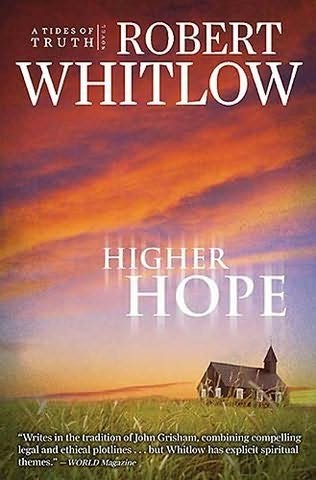
Robert Whitlow, Higher Hope

Robert Whitlow, Higher Hope, Tides of Truth, Book 2 (Thomas Nelson, 2009). Thanks to Thomas Nelson for the review copy.

Tami Taylor, a law clerk in a Savannah firm, finds herself in the middle of a libel case involving a bold and outspoken preacher who claims prophetic abilities. The case, and her relationships at the firm, cause her to reflect on her own strict conservative upbringing and about the role her faith plays in a legal setting. Whitlow has crafted an interesting character study about the struggle between past and future, faith and life. Tami is forced to evaluate what she thinks is true about God and about how she should follow God. Though it slows down at points, and dwells too much on the competition of two lawyers for Tami's affections, the story still draws you in. The legal portion of the book sometimes gets lost amid the other story lines, but it still forms the backbone of the action. In all, it is worth a read.