 I remember not really enjoying this book the first time I read it, but I found a very different experience this second time through it. Though it is not what you might expect of Clancy, without the trademark espionage, international political intrigue, and covert ops, it is great story of a different type. In Without Remorse, Clancy looks back to the development of John Kelly (later known as John Clark, or just Clark), the black ops expert who appears in many of Clancy's other books. Kelly has a sordid past, and this book takes us on a ride of love and loss. I think the most enjoyable and fascinating facet of this book for me was the ongoing struggle within Kelly about right and wrong, the nature of justice, and the allure of expedience. This book still has Clancy's trademark style, but with some different twists. And it shows his breadth as a writer. It may in some ways be one of his best.
Showing posts with label Clancy. Show all posts
Showing posts with label Clancy. Show all posts
Wednesday, October 21, 2009
Tom Clancy, Without Remorse
I remember not really enjoying this book the first time I read it, but I found a very different experience this second time through it. Though it is not what you might expect of Clancy, without the trademark espionage, international political intrigue, and covert ops, it is great story of a different type. In Without Remorse, Clancy looks back to the development of John Kelly (later known as John Clark, or just Clark), the black ops expert who appears in many of Clancy's other books. Kelly has a sordid past, and this book takes us on a ride of love and loss. I think the most enjoyable and fascinating facet of this book for me was the ongoing struggle within Kelly about right and wrong, the nature of justice, and the allure of expedience. This book still has Clancy's trademark style, but with some different twists. And it shows his breadth as a writer. It may in some ways be one of his best.


Tom Clancy, The Hunt for Red October
 This debut novel is still without a doubt one of Clancy's best. He takes you into the world of submarine warfare and weaves technical jargon with a great story. Jack Ryan, who begins to take shape in this book, emerges as an unwilling hero with a great dose of humanity. I loved this book as much as the first time.
Saturday, December 27, 2008
Tom Clancy, Red Rabbit
 In this 2002 installment in the Jack Ryan series, Clancy returns to Jack's early days in the CIA, after his run-in with the IRA in Patriot Games. In the hey day of the Cold War, with tensions in Eastern Europe rising, the new Pope, John Paul II, sends a letter threatening to renounce the papacy and return to Poland to shepherd his people who are buckling under communist rule. When word of his plans reaches Moscow, the politboro is concerned about destabilization in Poland that could spread across the Warsaw Pact. So Yuriy Andropov, the head of the KGB, sets a plan in motion to assassinate the Pope. Meanwhile, the CIA and the British SIS have gotten word of the letter, and are busy trying to guess the Soviets' next move.
 As the Soviets' plans unfold, an operator in the signals section of the KGB (a person who transmit coded messages), Zaitzev, is overtaken by the weight of the messages he is translating. Even though as an operator he isn't supposed to have an opinion about the messages, isn't really supposed to read them, he can't be a party to the murder of an innocent man. On his commute home, he has been seeing a new American ride the train, and suspecting that he might be CIA, he slips him a note on the train. The American, Ed Foley, is in fact a CIA field agent, and a careful courtship begins. Zaitzev wants out for him and his family, and, to get such a well-placed agent, the CIA is willing to comply. The "Red Rabbit," that is a communist who wants to defect, is a valuable source of communications intelligence about a wide array of soviet intelligence, so a plan is put in motion to get him out of the country. The CIA brings the British SIS in on the plan, which is to have Zaitzev take a train to Warsaw and then smuggle him across the border into Yugoslavia. Ryan takes part in that little bit of the operation, as the CIA representative on the otherwise British-run phase of the operation. The exfiltration goes off without a hitch, and Ryan is amazed to learn of the plans to kill the pope, and he quickly relays the information to Washington.
But, that leaves the CIA in a precarious position, walking the fine line between using the intelligence they get and protecting the valuable source. In the end, it is decided that they can't notify the Vatican because the source needs protecting, but Zaitzev is able to identify the probable assassin, so the Brits dispatch a team to try thwart his plans, surmising that he will try kill the Pope during his weekly tour around St. Peter's square. Ryan goes along, and they scout out probable scenarios for the shooter. They find themselves in the square, and have spotted the shooter, but Jack realizes that he's not looking at the Pope, but somewhere else. Just then, shots erupt from nearby in the crowd. The Pope is shot, but only wounded, the shooter is captured, as is the Russian assassin, who was there to kill the assassin so his actions couldn't be traced back to Russia.
Red Rabbit is another interesting and enjoyable installment in the Jack Ryan saga, though Ryan is both on the periphery as well as at the center of the story. But the facet of the book that pulled the story together was the character of Zaitzev. His own struggles with the information he was transmitting, and with the whole Russian disregard for God made for an interesting character at the center of the plot and pulled the book together. It may not rank as one of Clancy's best, but it is still vintage Clancy.
Tuesday, January 30, 2007
Tom Clancy, Rainbow Six
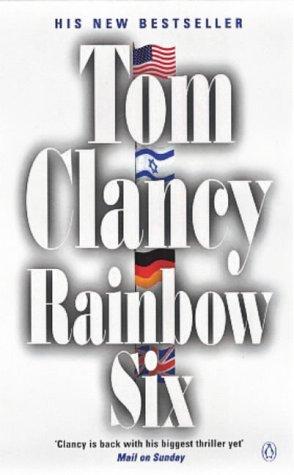
In this next book by Tom Clancy, he departs on a tangent from the Jack Ryan saga to follow John Clark, as he did earlier in his book Without Remorse. As part of the new post–Cold War world, terrorism is rising to be a major area of threat, as evidenced from Clancy's two earlier books, and also from our world situation today. In response to this threat, Clark, with the endorsement of President Ryan (who basically doesn't figure in the book), starts a special international squad, Rainbow, of highly trained special-operations troops to be a terrorism response squad. Joining him are Chavez, another of Clancy's favorite characters, and a broad cast of troops from the US, Britain, and other NATO countries.
They are quickly put to the test. Terrorist activity first at a bank in Zurich, and then at the home of a prominent businessman in Austria give the team a chance to show what they are worth. They carefully coreograph a response and decisively put down both incidents. Their third response is to a terrorist takeover of WorldPark (a EuroDisney immitation), and again their action is impressive and decisive. Each episode is full of Clancy's vivid descriptions of tactical maneauvers, technological advances, and personal stories. Vintage Clancy.
Part of the impetus behind these terrorist attacks is coming from John Brightling, head of Horizon Corporation. Brightling and a group he calls the Project are out change the world. They want to eliminate all but a chosen few humans from the planet, in what they see as the only way to save the Earth from human destruction. To do this, they want to raise global awareness of terrorism, in order to get their guy a consulting contract for the upcoming Olympic Games in Australia. That will be their delivery point of Shiva, an engineered form of Ebola that will spread from there throughout the world. Once the outbreak is known, Horizion plans to step in with a "vaccine" that is actually a virulent form of Shiva, thereby infecting most of those who haven't yet been reached with the epidemic. Only their own people and those they deem worthy get the real vaccine.
The last terrorist attack they plan before the Olympics is a direct attack at Rainbow, which they see as a threat to the success of their plan. So they carefully set up an ambush of Clark's wife and daughter (Chavez's wife) at their place of employment, the hospital near the base. They plan to ambush the Rainbow troops as they respond. But the plans fall apart when Noonan, the Rainbow tech-guy, disables all cell-phone communications and disables their ability to act in a coordinated fashion. Wife and daughter escape unharmed as Rainbow is again able to act decisively to counter the terrorist plot, but this time taking two losses and a few injuries in the process.
Their plan is working, until Dmitry Popov, the ex-KGB agent they have enlisted to set up the terrorist attacks, gets wind of the big picture for the Project. He is horrified by Brightling's intentions, and finds his way off of the Project facility in Kansas and heads to New York. He contacts Clark, and asks for a meet, and even though he set up the hit on Clark's wife and daughter, Clark accepts. As soon as he learns of the plot, Clark informs Chavez, who is consulting at the Olympics with a few other Rainbow troopers. They stake out the fogging system room (the planned point of deliver for the virus) and nab the Project member who is going to plant the virus.
As soon as Brightling realizes that he can't reach his man, and that things are falling apart, he orders all physical and electronic evidence destroyed, and gathers up the members who know the whole story of the Project's plans and flies them off to the Project Alternate facility in Brazil. But the FBI and Air Force are able to track the plane, and Clark decides that Rainbow will follow the planes down. Because they are sure most of the evidence has been destroyed and because they fear making the details of the plot public, FBI agents aren't sure about if the group can be successfully prosecuted, and if it should be. In face of this, Clark faces them head on, sending in his troops. He gives them an opportunity to surrender, but Brightling sends out armend men to counter the force. Using an advanced people-finding gadget that Noonan has been plaing with, Clark is able to vector in the Rainbow troops to neutralize the threat from the Project defenders. Once it becomes clear that the battle is won, Brightling and his group surrender. Instead of taking them back to the States, Clark destroys all of the facilities at the Project compound and releases the members into the jungle to try fend for themselves (to commune with nature, as he puts it).
With Rainbow Six, Clancy again demonstrates his narrative sense, as well as his ability to tell a great military story with a moderately complicated plot. He also builds some interesting and clearly flawed characters who just try to do the right thing. And the reader clearly wants to empathize with them. But there are some clear weaknesses in the book. One, a weakness that has cropped up in a few of his other novels, is torture. Clark is a character with a dark side, and torture, or the threat of it, is a necessary instrument to elicit information and serve a greater good. And at first blush, in Clancy's narrative world, that may seem true. But who should be allowed to weild this terrible sword, and decide when it's really serving a greater good. The fear that evil will win out makes it seem easy to do whatever we can, and at whatever cost, to make the good triumph. But we should never allow torture to be justified. It violates the basic humanity, of both the tortured and the torturer. And it most certainly flies in the face of our most basic Christian convictions about right and wrong, and about sin and reconciliation. Which brings up the other major flaw in Clancy's story: retribution. The one unasailable fact that seems to drive his logic as the story concludes is that the perpetrators of this ghastly plan deserve full and complete punishment for their intentions. They must be delt with, decisively. And if the law might have trouble doing that, or if we don't like all of the consequences, it's justifiable to bend the rules a bit to exact "justice" in a slightly different way. Again, the line of thinking is tempting, but it again sees retribution as good, and sees all actions toward that end as justifiable. The victims become the perpetrators in a new act of violence. Where does it end?
Friday, December 08, 2006
Tom Clancy, The Cardinal of the Kremlin

My reading of the Jack Ryan saga continues (a bit out of order) with this last of the Cold War installments from Clancy. Both America and the USSR are pushing for supremecy in the arms race, and the focus has turned to missle defense. Both sides are working feverishly on laser-based missile defense systems, to fry satelites and shoot down ballistic missiles before they can do damage to their targets. The US has a highly placed spy, the Cardinal, in the Kremlin, who has been passing them information for decades. Colonol Filiotov was a Hero of the Soviet Union, decorated for his valor in battle numerous times, but his patriotism had come to turn him against the party and the current power structure after the way his sons and then his wife had died needlessly. So he turned to passing information to the US. As the second-in-command of the Defense Ministry, he was perfectly placed to know all of the particuars about Bright Star, the Soviet missle-defense system. And the Soviets had made an important breakthrough. This valuable information had to get out. So Filitov proceeded to send it out by its usual means, but a small hitch in the courier chain, the inadvertant dropping of the film canaster aboard a subway, was witnessed by an off-duty KGB agent, who recognized the film for what it had to be, and followed the person who dropped it. That accident led to the whole chain falling apart. But the US didn't know how far back the chain had been followed, or if suspicion had fallen on Filitov. The slides on the film were exposed by the agent as soon as he realized he was being followed, but a few partial frames remained, showing something of the Bright Star installation. That limited where the leak could have come from, and suspicion fell to Filitov and his deputy, Bondarenko. Meanwhile, the Americans knew of the compromise, but they also knew that the information that Filitov had was invaluable, so they made another attempt at getting it out, using a brush pass with Mrs. Foley, one of the undercover CIA agents in Moscow. But Filitov was being closely watched, and the pass was broken up just before it happened, and Filitov was taken into custody. After a week of imprisonment, the Soviets broke him, and knew of his activities.
Meanwhile, Ryan was involved as the intelligence analyst on the negotiation of a new arms treaty with the Soviet Union, and the progress of the missile defense systems of both sides was a key to knowing how to negotiate. Cardinal provided essential information about what the Soviets were doing, ad Ryan also investigated the Americans' own progress. But the loss of Filitov complicated matters. Not only was it a major intelligence loss, but it also threatened to destabalize the Politburo, the Soviet ruling council. When it became known that a high-ranking member of the Defense Ministry had been compromised, and with another Politburo member in the pocket of a challenger because of his daughter's involvement as a courier for the CIA, it became clear that the whole power structore of the Politburo could be shifting away from the current leader, Narmanov, and is more open policies to Gerasimov, the head of the KGB, and a return to hardline doctrines. So Ryan and the CIA take action. Ryan puts himself out as bait, sending a message through to the Soviets that he is interested in becoming an informant if the Soviets can help get him out of some supposed FTC problems with some stock trades. They take the bait, and agree to meet with him the next time he is in Moscow for negotiations. But he puts one stipulation on the meet, that he must meet face-to-face with Gerasimov. When this happens, instead of turning informant, he confronts Gerasimov with the threat of making the caputer of the Red October public, as well as other things that would destabalize his power. Ryan tells Gerasmov that instead of making a power play for the Politburo, he and his family, along with the captured Filitov, must defect to America.
Gerasmov makes one last play, sending KGB agents to kidnap Major Gregory, a young genius working on the American missle-defense system. And they are successful in snatching him, but a simple traffic violation leads eventually to their failiure, as the Hostage Rescue Team is called in to recover this most valuable hostage. Had it worked, the great intelligence gained from Gregory might have been enough for Gerasmov to overcome the liabilities of the information the Americans could reveal, but with the failure of his play, Gerasmov decides to give in. He and his wife and daughter agree to the defection. His wife and daughter take off for his wife's home in Estonia, where she is met by John Clark, who has boated in off a US submarine holding just off the coast. Gerasmov himself goes to the prison and takes custody of Filitov, and they drive to the airport, where the US diplomatic delegation is getting ready to depart for home after negotiations. Gerasimov ties up his own driver, releases Filitov, and meets the US plane at the end of the runway. But Golovko, a KGB agent, and some others, have started to figure out that something is going on, and are racing to figure out what it is. They end up getting to the plane just as Gerasmov and Filitov are getting aboard. The Russians get out alright, but Ryan is left standing on the runway. After a few tense minutes, he is brought outside of the city to Prime Minister Narmonov's residence, where he fills the PM in on what has just transpired, or at least some of it. He is then returned to the American Embassy.
This is yet another great book in the Jack Ryan series. Worth reading. Even though some of the geopolitical elements are dated, the action and the characters give it life. And in this one, espionage takes center stage.
Friday, November 03, 2006
Tom Clancy, Executive Orders
Through a catastrophic terrorist attack, Jack Ryan has risen to the post of President of the United States. But the first days and weeks of his presidency are marked by challenges from a numer of directions, as various countries test the seemingly weakened US. Ryan's first task is to secure his family, and try begin reconstituting the government, which was almost totally decimated with the loss of almost all Senators, Congressmen, Joint Cheifs, and Supreme Court Justices, in addition to the President. His first days are further complicated by a challenge from the disgraced former Vice President, Ed Kelty, who makes the claim that he never officially resigned, and should be the rightful President. With the death of the Secretary of State, the person to whom he reported his resignation, definite proof of his resignation proves a bit difficult to obtain. But other challenges arise as well. Half way around the globe, an Ebola outbreak occurs in Zaire, and a doctor loyal to Iran manages to smuggle one of the infected patients out of the country, giving Mohammed Haji Daryaei, the leader of Iran, a very potent biological weapon. An Iranian assasin is successful in killing the leader of Iraq, and Iran takes overthat country, forming the United Islamic Republic, with aspirations of further conquest.
Daryaei's plan goes further, though. He dispatches a group of assassins to make an attempt on Ryan's youngest daughter, an attack that is thwarted thorugh some heroic actions by the agents guarding her. Daryaei also sends out twenty men armed with a weaponized version of the Ebola virus they have cultivated, infecting twenty conventions across the United States. Actions by China and India (through a consipracy with Daryaei) also turn up the heat on America. But quick work by doctors at Hopkins, the CDC, and the military, identify the problem, and Ryan shuts down all interstate travel to stop its spread. And as all this is going on, Kealty is spreading disinformation about Ryan's past CIA service out to the media in an attept to discredit him. But the truth, or at least a truer interpretation of events, does eventually get out.
The UIR also makes an aggressive attempt to take over Saudi Arabia and Kuwait, the first major step in the quest to take over the Islamic World. The US military suffers from the same exposure to the Ebola outbreak as the general public, and isn't in a position to be deployed, but two divisions are at the National Training Center in California, separated off from the outside world, and are clean of the virus. They are deployed as quickly as possible to Saudi Arabia and Kuwait to stand with those countries in repelling the UIR attack. And even outnumbered, they do just that through careful tactical maneauvers and the element of surprise.
In Executive Orders, Clancy has continued his Ryan saga with another book of international intrigue. But it again emphasizes his clearest strength, which isn't the complexity of his plots or the accuracy of his military imagery, though both of those are exemplary. His biggest strength, showcased here, is his studies of character. Ryan is a well-developed character who struggles with the burdens of command, the philosophies of leadership, the place of politics in public life and government, and the role of honesty in his daily pursuits. His own experiences provide a backdrop for his development, and we see how his past exploits and lessons bear on his decisions in the present. In essence, Clancy has built a character who tries to do the right thing. Clearly not without flaws, such as his temper, or such as a desire to see things in simple terms, Ryan is a character that could walk off the page, and further, is one you'd like to meet. He also develops a number of other characters, from Daryaei to John Clark to Andrea Price, who give the novel its depth and interest. This book is yet another worthy read in the Ryan chronicles.
Thursday, October 26, 2006
Tom Clancy, Debt of Honor

The Jack Ryan saga continues from The Sum of All Fears with this next massive installment. Ryan has stepped out of government service, but is called back again, this time as National Security Advisor to President Durling. Meanwhile, a complicated web of events is unfolding. A few business leaders in Japan have schemed to increase the power of their country. This grand plan has as its goal the seizure, along with China, of a large portion of eastern Siberia, to greatly increase the natural resources available to Japan. Meanwhile, the Japanese are made to realize their dependence upon America as an automobile accident causes the American public to push for more restricted trade with Japan (essentially enacting the same laws with regard to Japanese products that Japan enacts with regard to American products). This is the final straw, that pushes Japan into action.
The first major move of the offensive is economic, as a few major Japanese businesses, along with a well-placed buisenessman who has taken the lead position in a major American equity firm, begin a run on the dollar by dumping American T-bills. A few strategic moves lead to a steep decline in the value of American currency, and the corresponding rise in Japanese Yen. The day on the market turns out to be disasterous, but is made even more so because a second part of the attac, the loss of all of the data from the trades for that day, leaves doubt as to who owns what and who owes who money--in other words, confusion. The second part of the Japanese offensive also begins, with the quiet military occupation of Saipan and Guam. The third tier in the attack is the "accidental" crippling of two American aircraft carriers at the conclusion of a friendly military exercise, greatly reducing America's ability to project force in the Pacific. And with India occupying the attention of America's two carriers in the Indian Ocean with the threat of a military action against Sri Lanka, a very difficult stage is set. Ryan, as NSA, councils that the solution to the market crisis is to say that nothing officially happened after noon, when the data was lost. Everyone goes back to where they were at that point (an idea most traders would go for, because of the disasterous happenings of that afternoon). In order to counter Japan's military moves, America carefully strikes at their home country by destroying their air defenses, and especially their very advanced AWACS aircraft. This is done by stealth aircraft, by stealth helicopters, and also by some covert action by John Clark and Domingo Chavez. As the defenses of the Japanese homeland fall, it becomes clear that even the crippled America could strike at Japan. The wild card had become the fact that Japan had developed nuclear-tipped cruise missiles, but some careful attacks by America neutralized their missiles. Without this last card to play, the buisenessmen who had been pushing the offensive action were silenced, and a more orderly government was restored, all without a major offensive operation by America against Japan. But as events were resolving, a lone pilot of Japan's national airline fakes an in-flight emergency and crashes his plane into the Capitol building during a joing session of congress, which had been convened to swear in Ryan as the new Vice President, a post he was assuming after the VP had to resign in disgrace. Ryan survived, but almost the entire American government, including supreme court justices and the president, were eliminated in one stroke. A problem Ryan will have to deal with in the next book, Executive Orders.
The first time I read this book, I remember getting bored. And the first few hundred pages are a lot of information, but in true Clancy fassion he brings together a staggering array of plot lines into a great story. It deserves to rank with the rest of the Ryan saga as a great work of espionage fiction.
Saturday, October 07, 2006
Tom Clancy, The Sum of All Fears

In The Sum of All Fears, Clancy continues the Jack Ryan saga. This spectacularly written book details a terrorist plot to hurt the United States and to push us into war with the soviets.
An Islamic terrorist orgainization recovers an Israeli nuclear bomb lost in the 1973 war in the Golan Heights. After ascertaining what it is they have recovered, they quietly obtain the services of a retired German engineer to remake the bomb using the nuclear material from their recovered device. Using obtainable machinery (used in applications like astronimical telesope manufacture and other technical applications) they are able to engineer and manufacture a two-stage nuclear fusion bomb (Hydrogen bomb). Their plan for delivery is to import the bomb into the US and detonate it at the Super Bowl in Denver. And this is precisely what they do. Meanwhile, other important events are unfolding. Ryan is Deputy Director of the CIA. Ryan has suggested a plan for Mid-East peace centering around a peaceful solution to the situation in Israel: Isreael and Palestine are given discreet borders, including the total withdrawl of Isreal from the West Bank. The United states and the United Nations guarantee security for the Israelis and the Palestinians. Jerusalem, the center of the tension, is governed by a committee of three clerics, one Christian (the head of the Orthodox Church), one Islamic, and one Jewish. This three-person panel is in charge of the operation of a large Swiss Guard force in charge of physical security of the city. It's actually a very brilliant plan, one that one wishes could be engineered in real life.
Ryan has butted heads with the President and the National Security Advisor, and the National Security Advisor, Elizabeth Elliott, sets out to undo him. She thinks she has uncovered dirt on financial and sexual impropriety, and sets out to smear Ryan. But Clark, head of Ryan's protective detail, sees the effects of the lies, and sets out to spread the truth, first by convincing Ryan's wife that the allegations are true. Once that is accomplished he goes to the reporter that printed the story and convinces him that he has been merely used in a smear campaign. While all this is going on, the US is getting intelligence from Russia that the Russian president may be in danger of losing control of his country and his military. As events are quickly moving to a head, Ryan is doubting the veracity of the report.
Then the bomb goes off. US and Soviet agencies both detect the signature double-blast pattern of a nuclear detonation, and chaos ensues. Nobody knows where the bomb came from. There is no inbound ballistic path (meaning a missile), but that is all they know. A second part of the terrorist's plot immediately ensues, as they pose as soviet officers and instigate a skirmish between Soviet and US tank forces in Berlin. This becomes one of a series of cascading events that add to the chaos and make both the Soviets and the Americans wonder if the other side is pushing for war. All the while, fragmentary information lacks the needed clarity. But slowly, a picture is beginning to emerge that the device, which first looked too large for a terrorist device, may in fact be just that. Ryan has tried to communicate these findings to the President, but President Fowler and NSA Elliott have realized that they were supposed to be at the game, and are slowly coming unglued under the pressure. Ryan finally sees that the Hot-Line messages from the President to Moscow are becoming more escalated, and he breaks into the Hot-Line area and speaks directly with Soviet President Narminov, giving him the news that the US knows it wasn't the Soviets, and helping to instigate an immediate step-down in violence and a pull-back of forces. The terrorist plot almost works.
This long and involved thriller pulls you along through all one thousand of its pages. Clancy has woven a realistic (almost prophetic) plot together with very good character development and exciting action. Again, vintage Clancy, and certainly worth the read. It is a great opportunity to reflect on terrorism and its implications, and also spurs us on to hope of a real peace in the Middle East. Worth reading!
Thursday, September 21, 2006
Tom Clancy, Clear and Present Danger
This book has always been one of my favorites. It was the first Clancy book I read, and got me hooked. It is classic Clancy. He brings together diverse elements of the plot into a great narrative. It is full of detail and interesting characters.
It’s a tough book to summarize, but I’ll try to hit the high points. Drugs are a major threat to America. In an election year, the President decides to do something about it. He approves a covert operation to send US troops into Colombia to recon landing strips used by the Cartel, and radio info about drug flights, which are then intercepted. This is going fine, but when the Cartel successfully kills the Director of the FBI while he is in Colombia, the mission changes, and the troops are redeployed to actively take out the drug production operations. They also take out a number of the leaders of the cartel using precision bombs. These operations are successful, but the Cartel, and their chief intelligence operative, Felix Cortez, start to figure things out. And Cortez is also able to deduce who is in charge of the operation—James Cutter, National Security Advisor to the president. So he blackmails Cutter, threatening to make the whole operation public, especially including the deaths of numberous civilians in the “precision bombings.” Cutter agrees to strand the teams in Colombia, allowing Cortez and the Cartel to capture the troops and claim victory, while at the same time reducing the volume of shipments to the US, thus allowing the President to claim victory. Jack Ryan is acting Deputy Director of Intelligence for the CIA. He learns of action the US is taking, and comes to figure out that the troops have been stranded. So he organizes a mission to get them out, and goes himself. The troops are successfully extracted, or at least the troops who have still survived are.
Clancy’s book is unparalleled as espionage fiction. He has almost a genre unto himself—or he at least sets the standard. But his book is also a great study in character, and in the art and conduct of war. He illumines some of the implications for terrorism for our understanding of how nation-states conduct war and respond to violence against them. In that way, it is actually amazingly current, and proves to be an imformative and thought-provoking look at responses to terrorism, both good and bad.
Thursday, September 07, 2006
Tom Clancy, Patriot Games

An exceptional book. One of the best books in the spectacular Ryan saga. In Patriot Games, Ryan finds himself the target of a small extremist group from Northern Ireland, the ULA, after he disrupts an attempt by them to kidnap the Prince of Wales and his wife and child. The ULA retaliates by attempting to murder Ryan's wife and daughter on their way home. They succeed in seriously injuring both of them, but they escape death. It also becomes clear that they had planned on simultaneously murdering Ryan. This unprecedented attack by foreign terrorists on American soil, and the attack on his family, sends Ryan to the CIA, to seek out the people who have made such a personal attack on him. He works with intelligence information to understand the motives of the ULA, and to find them out. But before they succeed in nailing down their position and intentions, another attack occurs. This time, a large force of terrorists attak the Ryan home, Perrigrine Cliff, while the Prince and Princess of Wales are visiting. A pitched battle ensues, and Ryan and company escape to the water down the cliff, and manage to lead the attackers to the Naval Academy at Annapolis, where the encounter more force than they can withstand.
The book is an unparalleled read. Clancy has built great characters, an intricate plot, and exciting action. If you've never read Clancy, this is a good place to start. For me, this was at least my third or fourth time through this one, and it was just as good as ever.
Subscribe to:
Posts (Atom)