Showing posts with label Theology. Show all posts

Wednesday, December 07, 2011

Tony Reinke, Lit!

"A wide gap separates a reader who simply consumes books from a reader who diligently seeks wisdom" (178). In this thoughtful and practical book, Tony Reinke argues for the value of reading as a Christian discipline, and helps encourage readers to develop wise reading habits. It is a book in two parts, the first being a "theology of reading," the second being a collection of practical advice for becoming better readers.

The foundation of Lit! is the contention that God's illumination can come to us through books, and that truth and beauty are gifts of God that can be reflected in Christian and non-Christian books alike. But equally as foundational is that God's truth is most fully embodied in Scripture, and all other reading that we do must be filtered through the truth of Scripture. "We must be determined to read the imperfect in light of the perfect, the deficient in light of the sufficient, the temporary in light of the eternal, the groveling in light of the transcendent" (28). This means we must always be on the lookout for an author's worldview and the truths she or he is implicitly or explicitly conveying, even as we also seek out the beauty of God's truth, which can be expressed in unexpected places or ways. This means that, once we've developed a foundational knowledge of Scripture and the worldview it builds, we should be eager but discerning as we seek out the illumination of truth wherever it may be found, even in non-Christian works which may have important insights or perspectives to lend.

The second major section of Lit! is a practical guide to reading, both for those who are not already readers and for those who are. Reinke gives advice on what to read, as well as on how. The advice tends to be very practical, and really emphasizes that reading should be intentional. We should be thoughtful in the books we choose, and deliberate in the way we read. One of the nuggets I helpfully gleaned from him is that we shouldn't hesitate to drop a book part way through, or only read selectively, if that best suits our purpose or if we are finding that it isn't worthwhile. So many of his other suggestions comport well with my own discoveries and habits as I have developed as a reader, such as marking in your books (I highly recommend marking in your books, and Reinke makes a good argument for why, as well as describing how he chooses to do it), reading multiple books at once, and reading reviews, for instance. He also helpfully discusses how the internet is effecting our reading habits and our ability to concentrate, something I worry about with myself and even more for my children, calling us back to the development of sustained concentration.

I loved this book. As a passionate reader, this book resonates with my reading heart. For those of you who already share this passion for reading, this book can help provide both practical advice for honing your skills as well as helpful theological context in which to place your reading. And it is just simply a pleasure to read a book that extols the virtues of something you love. But this book is also for those who don't read, and who don't really want to. He makes good, simple arguments for why and how people who don't have interest, time, or enough perceived ability can and should begin to develop this most important and nourishing habit. There may have been one or two places where I didn't particularly agree with his advice (one specific instance comes when he encourages readers to write questions you want answered in the front cover before reading it, which is fine, but he then asserts that one way to find holes in the authors arguments is by seeing if he answers your questions; while I agree that we should read critically and curiously, and that we should look for holes in the author's arguments or logic, the fact that the author doesn't answer the questions we asked at the outset may reflect more the author's purpose than a failure of argument). In all, I warmly commend this outstanding little book. It is well written, thoughtful, and readily applicable. It will ignite or deepen a love of reading.

Tuesday, October 04, 2011

Eric Metaxas, Bonhoeffer: Pastor, Martyr, Prophet, Spy

In Bonhoeffer: Pastor, Martyr, Prophet, Spy, Metaxas has given us a very readable biography of one of the most remarkable characters of the twentieth century. Bonhoeffer's theological impact is large and continues to be felt widely, his ecumenical connections and his role in the church struggle in Germany propelled him to prominence in the fight against Nazism, and his role in the plots to remove Hitler gave him a place in the military and political history of the Second World War. So he is certainly a man to be reckoned with.

Where Metaxas's biography shines is as he seeks to convey the deep conviction and faith that animated Bonhoeffer's thinking and living. A deeply academic man, with a broad education, he also took very seriously the living and practice of his faith. And Metaxas's biography is careful to trace this stream as he moves smoothly through the various important periods in Bonhoeffer's life.

Bonhoeffer biography, in fact Bonhoeffer scholarship as a whole, is contested ground these days. Stephen Haynes wrote a book in 2004, The Bonhoeffer Phenomenon, that sought to show the various ways Bonhoeffer has been interpreted (or even co-opted) by various and diverse groups, how his remembrance goes from technical theological interaction to something approaching hagiography. Simply the presence of his popular Cost of Discipleship as a frequent must-read book among young evangelicals and the popularity of his idea of "religionless Christianity" among liberal scholars shows the breadth of interest in him. On the whole, I think Metaxas has navigated the rough waters well. He doesn't seem to excessively elevate Bonhoeffer, noting for instance that his family rarely if ever went to church while he was growing up or that his father was mostly opposed to religion, but he also doesn't shy away from Bonhoeffer's evident and deep faith that drove his thinking and acting. Instead he presents Bonhoeffer as a vibrant and scholarly Christian dedicated to living a life devoted to God but also willing to wade into complex waters without seeking simplistic answers but instead seeking to faithfully live as a disciple of Jesus.

I greatly enjoyed this book, and was deeply inspired again by Bonhoeffer's life and his writings, which are liberally but not overwhelmingly excerpted and quoted throughout the narrative. Metaxas tells the story of Bonhoeffer's education and travels, details his involvement with the Confessing Church and its seminary, highlights his major theological writings without focusing on them in detail, and chronicles his involvement in the plots to kill HItler. It is compelling reading, and I highly recommend it.

Tuesday, July 19, 2011

Rick McKinley, A Kingdom Called Desire

In A Kingdom Called Desire, pastor Rick McKinley takes a look at the life of discipleship to Jesus through the lens of desire.In a culture keyed in on finding the thing that will make us the most happy, McKinley calls us to carefully search out our desires, first because God in fact created them, and second, so we can honestly face up to the question of whether we do in fact desire God the most. And it is in the latter, the deep and true desire for God, that McKinley develops his picture of kingdom living. And part of this involves recognizing honestly the desires God has placed within us and recognizing and developing the God-given desire for him that rests beneath them. In a key chapter, "Life and Death," McKinley gets to the heart of what this transformation of desire entails, as he reflects on the need to face our own mortality, and as we do this, to learn to cling to the cross. "I wanted to cling to one part of the gospel: his death for me. I don't want to grapple with the implications of my death in him" (53). Instead of making our own lives into idols, we must come to grips with our own death in Christ, and our new life as Christ lives in us. It is then that we learn to focus on Jesus and desire him and the coming of his kingdom. And key to this new life is that we no longer act out of duty, of a need to produce the life God can appreciate or that can make us worthy before God, we are no longer seeking to do the right thing to avoid negative consequences, but are instead living into the life God has for us, and sin begins to loose its attraction for us. This transformation of life then begins to work itself out in our lives as we begin to recognize the God-given desires that are unique to us, and we see the way God has made us to be, allowing us to seek out things that are God-glorifying and are at the same time fitting to the way God has made us to be, a deep freedom to become who God made us to be in him.

McKinley's book has a nice conversational quality that keeps it from becoming either too academic or to preachy. He also takes an honest tone that gives credibility to his discussion. And I found his discussion of the concept of desire to be overall a helpful one, as I think finding our fulfillment through the realization of our own personal desires is a key idea in our culture today, but also has some potential as an entry point for reimagining our relationship to God. The danger, of course, is of making the gospel a self-help program or a path to personal fulfillment, though I think McKinley is aware of these dangers and steers mostly clear of them. I may quibble with a few points, but overall found his approach to have some merit. I especially appreciated his call to honestly investigate our desires, to see if we truly are desiring God or if we are merely paying lip service to our faith. IN all, this book has some good things to say to those who want to desire God and live for him.

Thanks to the publisher and Amazon.com Vine program for the review copy.

Thursday, November 25, 2010

Richard Stearns, The Hole in Our Gospel

Thanks to Thomas Nelson for the review copy.

I loved this book! And I hope you read it. That's the only way I can start this review. Richard Stearns, the president of World Vision, has written a powerful apologetic for that important Christian ministry, but more than that, he has challenged evangelicalism to espouse a fully orbed gospel of the kingdom.

The book is part testimony and autobiography, with Stearns recounting his own journey from new Christian to successful corporate executive to president of World Vision. And it is a great story, easy to relate to, and well told. I found it easy to relate to Stearns' journey, his excitement for the gospel but also his reluctance to step out of his comfort zone into new territories. His story is written with obvious honesty and candor, and I thin it lays important groundwork for and integrates well with the book's overall message about broadening the way we understand the gospel and our role to spread the gospel to the world.

The core vision of the book is about getting beyond a traditional view of the gospel as an "otherworldly" message of hope for the hereafter to a Jesus-centered kingdom vision about changed lives, spiritually and physically. We are called not only to preach but to also embody the gospel. "This gospel that we have been given—the whole gospel—is God's vision for a new way of living. It inaugurates the reality of God dwelling within us, His followers, no longer in a temple in Jerusalem. . . . God's kingdom was going to begin on earth through the changed lives of His followers, and its hall markes would be forgiveness, love, compassion, justice, and mercy" (276).

Stearns is well aware of the dangers of preaching a "works" righteousness, and he addresses that concern a couple of times in his writing. He is also aware that some may want to read his message as a call away from traditional evangelistic preaching to a social gospel, a charge he anticipates and subverts a number of times as well. In all, I think Stearns has done the church a great service in writing this call to follow Jesus in his kingdom ministry. For if God truly loves the world, aren't we going to do everything in our power to overcome disparity, disease, poverty, and oppression as we do everything we can to overcome spiritual blindness, poverty, and oppression. And, in fact, the two can't and shouldn't be separated. For each side of the gospel fits with the other: a preaching without works of love is only words, and a life of compassionate action is one of the best apologias for the gospel we preach. Highly recommended.

Friday, September 10, 2010

Max Lucado, Outlive Your Life

Though it's not my usual academic fare, I offer below a review I just finished for Max Lucado's newest book. In brief, great book. Thanks to Thomas Nelson for the review copy.


Outlive Your Life is a compelling call to shake our complacency and rediscover our world through God's eyes. In these fifteen lessons shaped by the book of Acts, Max Lucado challenges his readers to look at their lives, their surroundings, and especially the people who surround them with a fresh and God-shaped perspective. Taking a cue from the way the gospel revolutionized the disciples and their ministry, even in uncomfortable and counter-cultural or even counter-intuitive ways, we too are to take up the kingdom life.


With his characteristic talent for pastoral insight, but in a way that surpasses other books of his that I have read, Lucado makes a clear and impassioned plea for so much more than cultural Christianity. He thinks of our complacent life like living in a clamshell: "Most of us have learned to insulate ourselves against the hurt of the hurting. Haven't we?" (23) Instead, God calls us "to unshell [ourselves] and partner with [Him] in [His] mission of love" (29). And that is what this book is all about, a new perspective, that looks beyond ourselves and our own interests to the interests of others, to the very interests of God. One great but uncomfortable point that typifies his challenge to readers is his assertion that "Poverty is not the lack of charity but the lack of justice" (106). We can't truly be Christ-followers and live life blind to those around us, blind to suffering, indifferent to injustice. Instead, we need to "outlive our lives," with a broader view and a renewed call to action.


I am happy to pass along that I enjoyed this book. It makes a great point (similar to Richard Stearns' The Hole in Our Gospel), is easily readable, and contains some great stories and illustrations for his points. And it serves as a clarion call to a broader vision, renewed commitment to prayer, and imperative for action. I hope this is his most-read book ever.

Sunday, August 08, 2010

M. Daniel Carroll R., Christians at the Border

Christians at the Border is a thorough and timely study of the issue of immigration in America. Written by an Old Testament scholar who is a Guatemalan-American, and who lives and teaches on both sides of our Southern border, the perspectives Carroll R. brings are essential. He carefully looks at the situation today, showing the great complexity which must be comprehended as we look at immigration (including things like where people come from and why the come, the economic pressures on both sides of the borders, and the broader history of immigration in America). He then looks back into the Old and New Testaments to see how their witness can be brought to bear. In both of these areas, carefully looking at today's context and exploring the biblical context and teaching, the book shines.

The fundamental insight that Carroll R. uses to reframe the debate, and one that I think is essential as we move forward, is to recognize that the debate today must be shifted from one about "immigration" as a concept to a debate and discussion about immigrants, human beings made in God's image who deserve our respect, care, and concern. Especially as Christians, we must come to grips with the sojourners among us (who are often, incidentally, fellow Christians), and must seek both temporary and long-term solutions that create and maintain justice as well as express and embody our identity as God's agents on earth.

The discussion in America today about immigration is a great opportunity for the body of Christ to exemplify what it means to love God and neighbor. There is no doubt that we must get beyond entrenched political positions and party alignments, as well as beyond oversimplifications and false dichotomies and seek new ways of of living and acting as Christians in the world. As Carrol R. concludes, "The decisions that are made and courses of action that are recommended [in a Christian approach to immigration] should be commensurate with the life of Jesus—his actions, his teaching, his cross."

I highly and unreservedly recommend this book. It is very readable, just as it is also thorough and careful. First-hand experience is melded nicely with research, and careful biblical reasoning is brought to bear with wisdom on a divisive issue with an always irenic yet prophetic tone. Read this book and be challenged!

Monday, May 03, 2010

Paul Copan, "True for You but Not for Me"

True for You, But Not for Me: Overcoming Objections to Christian Faith
Thanks to Bethany House for the review copy. In this second edition of "True For You But Not For Me," philosopher Paul Copan lays out a very clear and readable exposition of the philosophical foundations for Christian belief. The book is oriented around responses to common objections, with each chapter focusing on a particular slogan or objection, such as "It's all a matter of perspective," or "Christianity is arrogant and imperialistic." The chapters are divided up into five parts, which move in progression from the general concept of truth (looking at relativism and moral relativism in parts one and two), to the basic truth of a God-centered worldview (religions relativism, part three), to the centrality of Christ (parts four and five). This organization mirrors Copan's overarching method for apologetics, what he calls "Truth-God-Jesus," asserting that an understanding of the existence and importance of truth will provide the foundation for a genuine belief in God, which will in turn provide the necessary framework for recognition of Jesus Christ as the only way to be saved.

A few notes about the content, which I won't otherwise attempt to summarize here because of the breadth of the treatment. First, he emphasizes over and over (to good effect) the exclusivity of supposed "relativist" philosophies, whether in regard to truth, morality, or religion. He also engages John Hick in extended dialogue in part three regarding religious pluralism. Also worthy of note is that part five consists of an extended discussion of the fate of the unevangelized, with a number of live evangelical options presented and considered (he seems to lean toward a middle-knowledge view, which he ends with).


Copan argues very clearly, and lays out complex issues in a helpful and accessible way. Each chapter is concluded with a bullet-point summary of the important arguments made in the chapter, making the book a ready reference. Copan also demonstrates broad familiarity with the biblical text and up-to-date knowledge of a good range of contemporary biblical studies (with well-placed references to, for example, Richard Bauckham, N. T. Wright, Douglas Moo, Ben Witherington, etc.).


In all, I would say Copan's book achieves its aims admirably. It will serve Christians well who want to better understand their faith and who want to know how to respond to or how to maintain their faith in the face of many common and often vexing objections.

Wednesday, March 17, 2010

David Murrow, The Map: The Way of All Great Men

Thanks to Thomas Nelson for the review copy. In The Map, David Murrow, the author of Why Men Hate Going to Church, uses the metaphor of a map, along with a creatively told fictional tale of its discovery, to describe the spiritual journey of a man. He begins with a ten-chapter tale of the map's discovery in an ancient manuscript in a Grecian monastery by the monk Gerasimos, and of his own involvement in the project as a journalist and writer who could popularize the discovery. But things aren't so simple when he discovers he is being pursued by a mysterious group with unclear motives. Someone must want the map for personal gain. David goes to the monastery to meet with Gerasimos, and he is taught by the monk about the journey the map describes. He is then finally introduced to the map.

The map itself, described in an ancient document entitled "The Three Journeys of Jesus," is actually a key to understanding Jesus own life as depicted in the Gospel of Matthew as three journeys, submission, strength, and sacrifice—three journeys that all men are to emulate in a life of discipleship.

In the second half of the book, following on this interesting fictional account, Murrow fleshes out these three journeys he finds in Matthew's gospel. The first, submission, is found in the early part of the Gospel (chs 1–7). It entails a journey toward the feminine, and is characterized by submission to God. The second is strength, and is found in Matthew 8–25. It is a journey of assertion and strength, a journey toward the masculine. The final journey is sacrifice (Matt 26–28), a journey back in the feminine direction, focused on handing over control, passing on responsibility, training up the next generation.

I found much of value in Murrow's creatively shaped handbook on male discipleship. I think he has indeed picked up three important themes of discipleship and described them well. His assertion that he has found a hidden map in the Gospel of Matthew is more tenuous, I would think, though that doesn't totally undermine the key insights. I also found his description of these stages or journeys in terms of masculine and feminine as a mixed bag. In some senses, it is helpful to see how these stages relate to typical tendencies or traits aligned with one gender, and to warn of the pitfalls that might be typical of especially men, means it has its use. Though in a more absolute way I don't think they were necessary for the book's key insight. In terms of a book directed toward men, and the vision of male discipleship it forms, I think Murrow's book has much value. It is a helpful corrective to some male-directed books that seem to glorify masculine traits and tendencies at the expense of important biblical themes like submission and sacrifice. So there is no doubt the book has great value for that alone.

In all, I found a few points on which to quibble, but I clearly think Murrow has identified three important themes in the life of the disciple, packaged them creatively with a fictional tale and a helpful map, and directed them well to a male audience. I hope this book is read widely and that it engenders a dialogue about the shape and purpose of the Christian life, especially the Christian life of a man.

Friday, February 05, 2010

Dietrich Bonhoeffer, Life Together

I highly recommend this classic work on the importance of Christian community. Coming out of his experiences in the Confessing Church seminary in the years leading up to WWII, Bonhoeffer's spectacular book both outlines the theological foundation for a robust and intentional communal life, but also gives practical advice on how to bring it about. While we certainly won't all be participating in the daily type of community that Bonhoeffer envisions (though it is very different from a cloister life, in that it is intentionally pointed toward and among the world in service), his vision is filled with great wisdom and insight for appreciating and reinvigorating our participation in our churches and smaller fellowship groups today. Teaching about Bible reading, prayer, service, and confession, Bonhoeffer paints a picture of the Christian life that preserves one from self-absorption and brings one into the support and fellowship of the communion of saints as we encounter Christ in one another. Truly a must-read.

Wednesday, February 03, 2010

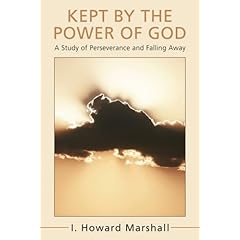
I. Howard Marshall, Kept by the Power of God

In this classic study (published originally in 1969 and republished with a new substantive epilogue in 1995), Marshall looks at a key theological issue in the New Testament, the perseverance of believers. In a setting of persecution, the question of perseverance is one that arises often in the NT texts, and it is an important pastoral issue still today. But it is also extremely useful as a lens through which to view the NT understanding of salvation, election, judgment, and many other interconnected ideas. In short, it is a vital test case, or maybe better put, it is essential data for a robust NT doctrine of God and of salvation.

Marshall digs in to the relevant NT texts by first investigating the OT and Jewish background concerning perseverance. He then moves through the various corpora in the NT: the Synoptics, Acts, Paul, Pastorals (may or may not be by Paul, but treated separately from though with an eye toward the undisputed Pauline corpus), Hebrews, the Catholics, and the Johannine literature. This systematic study is largely exegetical, as Marshall works carefully with the individual texts on their own before summing up each author's perspective.

Marshall then brings all of this data to bear on a conclusion: "We can say firmly that, while it is possible for a Christian to fail to persevere after a genuine experience of salvation, yet, with all the promises of a faithful God to sustain those who trust in Him, the main emphasis of the New Testament is on confidence and assurance of final salvation" (210). In short, while we can't explain away the possibility of falling away, believers may be "confident of persevering through the power of God" (199).

I am greatly appreciative of Marshall's study. I think it is a wonderful exegetical survey of this important area. And I think it provides an important testimony to the work of God in salvation. It obviously has much bearing on the Calvinist-Arminian debate (though Marshall prefers the designation "non-Calvinist" in this context because the second position isn't necessarily in conformity with Arminius). He has many insightful discussions of election, calling, monergism vs synergism, and some of the other relevant theological areas that are touched on by this topic. I greatly benefited from this book, and think Marshall has taken a robust, biblical line on the question of perseverance and, more broadly, on God's working in salvation.

Saturday, November 21, 2009

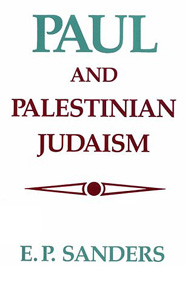
E. P. Sanders, Paul and Palestinian Judaism

Few books have impacted biblical studies in the past decades more than E. P. Sanders' Paul and Palestinian Judaism. This groundbreaking book has been instrumental in a reevaluation of many long-held presuppositions about Judaism at the time of Paul and Jesus, and about how Paul related to that heritage. I've long heard it referred to, cited, and criticized, so I thought it was finally time that I read it for myself. And I'm extremely glad I did.

First, a word about my reading, which was a bit selective. I chose to read the conclusions he draws at the close of the first two thirds of the book, dealing with his reevaluation of Judaism and his assertion of "covenantal nomism" as the overriding framework at the turn of the era. I then read the remainder of the book, dealing specifically with Paul and his relation to the Judaism of his day as reconstructed by Sanders. I'm not competent to comment on the foundational aspect of his thesis that Judaism is typified in Paul's day by covenantal nomism, that entry into the covenant was by God's grace and that works served to maintain that relationship as a way of staying in, other than to say it is obvious that Sanders was instrumental in awakening a reappraisal of the sources and a questioning of some long-held assumptions. I have found it to be a compelling argument, even if not completely convincing on all counts.

His chapters on Paul are uniformly well written and well argued. His foundational claim is that Paul reasoned from solution to plight, and not the other way around, so that the driving force in Paul's thinking was not what was wrong with Judaism or the Law or with humanity in general, but instead by his conviction that Jesus Christ is Lord and is the only way for salvation. This basic premise causes a reevaluation of Paul's thought process and illuminates Paul's thinking in a fresh way. Instead of focusing on justification by faith as the peak of Paul's theological reasoning (his "pattern" of religion in Sanders' terminology), participation with Christ moves more toward center stage. It is the need of Jesus Christ as Lord that is the decisive factor in his distancing himself from Law observance: not that it is futile or wrong-headed or unable to attain righteousness, even if these are also his conclusions, but first and foremost that it isn't focused on Jesus Christ as Lord. His focus on the participationist stream of Paul's thinking is especially enlightening, as he shows how important the theme of dying with Christ is to Paul's understanding of salvation. In his discussion of works, Sanders asserts that "Salvation by grace is not incompatible with punishment and reward for deeds," (517) and that is the position he asserts as Paul's. With regard to covenantal nomism, he says that Paul's view of works is in perfect agreement (518) with the Judaism of his day, but (and this is an important qualifier) Paul's pattern of religion is fundamentally different than covenantal nomism. He stresses this a number of times, asserting that while there is substantial agreement, there is a basic difference (548). That difference is Christ. Paul's pattern of religion, described as "participationist eschatology," is typified by participation in Christ, a change in lordship from the lordship of the flesh or sin to Christ, and being under grace instead of under the law. It is a transfer that takes place, and that is decisive. Even though Paul does spend a good bit of time talking about the role of works, and is rightly concerned with justification by faith, which Sanders includes in his scheme, it is Christ that takes center stage, and union with Christ that is the driving force of his thought. Anything that is pointing toward a different goal is entirely useless, and thus the observance of the Law in order to obtain righteousness is not so much destructive or in need of reformation as it is working in a totally different order than union with Christ.

Even though his discussion of Paul isn't much more than a hundred pages, this short review can only scratch the surface of this seminal work. I came to it with a pretty good acquaintance with many critiques of Sanders' work, and I look forward to continuing to sift this great piece of reasoning and argument. At the very least, it is abundantly clear that he has brought to light a number of themes in Paul that are too often underplayed or subordinated (such as participation or lordship), or at least, that were until after he published this study. I look forward to continuing to study Paul's theology and soteriology, and this important work is clearly one of the indispensable stopping points along that way.

Sunday, November 01, 2009

Michael Gorman, Inhabiting the Cruciform God

In this study of Pauline soteriology, Gorman focuses on Paul's "grand narrative" of kenosis, justification, and theosis as key themes for understanding Paul's view of salvation in Christ. The key text for explicating the narrative is Phil 2:5-11, where the kenosis and exaltation of Christ form the key movements in the description of Christ's incarnation. For Gorman, this narrative is key to understanding Christ, and salvation, and even more, it is key to understanding God. He sets as one of the book's key agendas the claim that "cruciformity is theoformity, or theosis," built on the foundational claim that "kenosis (self-emptying) reveals the character of God" (2). This key element of the thesis is worked out in the first chapter of the book, with a careful study of Philippians 2 and it's implications for Paul's master story. He then turns to an extended study of justification as co-crucifixion, a participation in the life and death of Christ, and specifically in Christ's covenant fulfillment. (Thus, the pistis christou debate features prominently in the chapter, as the subjective genitive reading there is an important element in the argument, though it doesn't stand or fall solely on that point.) He then turns to holiness as the actualization of justification (not some subsequent and separate movement) and closes with an argument for nonviolence as an essential part of Paul's entire viewpoint.

I greatly enjoyed Gorman's important work. It is well written and clearly argued throughout, and he demonstrates a thorough familiarity with Paul and his letters. I am extremely sympathetic to the core theological argument of the book, that kenosis not only pertains to Christ but also reveals something of the character and manner of working of God the Father as well. His chapter on justification is likewise illuminating, and I think he is convincing that theosis (as he carefully defines it) is an element in Paul's soteriology, one that is often neglected in the Western tradition. Whether "justification by co-crucifixion leading to theosis" is the one soteriological model for Paul is most certainly a more difficult argument to pull off, but at the least Gorman has demonstrated how the "crucified with Christ" language and thought patter in an important one for Paul. His chapters on holiness and nonviolence are similarly thought-provoking and challenging, and I have no doubt that this work overall provides an argument to be reckoned with. Gorman constantly brought me back to the text of Paul's letters to notice details I had previously missed while at the same time making a synthetic argument for an overarching framework that is helpful in thinking like Paul thought. So while I may not agree with him in all particulars, this is clearly a great work, and I am glad to recommend it.

Tuesday, October 20, 2009

Gordon Fee, God's Empowering Presence

I have no intention of doing this important work justice in this short review, so instead, let me give a few words of appreciation. This nearly encyclopedic book encapsulates what must have been years of research and months of careful exegesis. The first three-fourths of the book consists of a passage-by-passage look at every mention and allusion to the Holy Spirit in Paul's letters. Each passage is exegeted with care, always with an eye to its context and its place in the larger argument of the letter. I had intended to only skim these chapters of exegesis, dipping in at what seemed to be important points, but kept finding myself absorbed in Fee's writing, and though I didn't read it in its entirety, I have no doubt it would repay careful study. The book then closes with a section of synthesis in which Fee brings together the fruits of his research.

The conclusions, like the exegesis they follow, are too extensive to summarize here, other than to say that Fee makes a very convincing case for the importance of the Holy Spirit to Paul's thinking, as well as to Paul's very life. I cannot recommend this book highly enough to anyone who is interested in Paul's life and letters or in the doctrine of the Holy Spirit. Fee also has, by nature of his own Pentecostal background, a keen eye to how this doctrine has been understood or misunderstood in contemporary formulations and church practices, and this book provides a well-grounded corrective to many distortions. If you're even considering this book, don't think twice. It is not to be missed.

Frank Thielman, The Law and the New Testament

Frank Thielman is a Pauline scholar at Beeson Divinity School. In addition to his very readable commentary on Philippians in the NIVAC series, which I enjoyed studying through, he has written a number of books focusing on Paul's understanding of the law. This book broadens that focus out to include a survey of the relationship between the law and the New Testament, especially as it is envisioned in the five major streams of the NT that directly take up the question: Paul, Matthew, John, Hebrews, and Luke-Acts. Thielman deals with each author in turn, looking at their distinctive approaches to the law, with a focus on areas of both continuity and discontinuity. In the final chapter, he draws these streams together by both looking at how they differ in emphasis but also how they hold essential elements in common. He summarizes his comparison of the five authors by placing them in three categories:

1. Paul and Matthew stand together in their interest in the ethical use of the Mosaic Law.
2. John and the author of Hebrews stand together in their symbolic use of the law.
3. Luke stands by himself in his use of the law not only in ethical and symbolic ways but also to construct the story of Gods saving purposes. (168)

He also highlights three basic issues that are common ground among the five authors:

1. The Mosaic law no longer regulates the lives of God's people.
2. A new "law" has taken its place.
3. the Mosaic law remains valid, but in a new way. (176)

His final sentence sums up his study well, "Continuity is present, but the gospel is something new" (182).

Thielman's study of the law is well written, and provides a very clear introduction to this area. He is careful to look at each author in his own right, looking at the major arguments of the various letters and then highlighting how the issues surrounding the law fit into this larger picture. His chapter on Paul was especially well done, and is a very helpful study that illuminates these major components of the letters to the Romans and Galatians. This was a worthwile read, and I'm glad to have it on my shelf for future reference. It is clearly a textbook, but is no worse for that fact.

Wednesday, July 15, 2009

N. T. Wright, Justification

Justification is one of the core doctrines of the Christian faith, and in both evangelical and more mainline circles, it has been contested territory for a generation or more. N. T. Wright's Justification is truty a book to be reckoned with. It is a comprehensive (though, as the author admits, not exhaustive) statement of the place of justification in Paul's thought. Much has been written about this highly anticipated contribution from one of today's most noted scholars, both in appreciation and in protest. I find myself far more appreciative than anything for this carefully reasoned book.

Wright begins by laying out some important groundwork for the present book by locating it especially within the evangelical conversation concerning the classical "Reformed" view of justification, especially as espoused by John Piper, and the new perspective on Paul, of which Wright could be considered one of its primary contemporary proponents, though he seeks to provide "fresh" perspectives that move beyond what is often termed the "new" perspective. Others have carefully laid out the specifics of Wright's argument, and I won't do that here. Instead, I'd like to extend some words of appreciation and interest toward some of Wright's major themes.

Clearly, the largest idea that Wright advocates for is the locating of the doctrine of justification, and the understanding of the "righteousness of God," firmly within the context of covenant. He describes God's righteousness as God's covenant faithfulness, and, more specifically, God's faithfulness to the one-plan-through-Israel-to-the-world. The problem that God addresses in the Messiah is that Israel has failed in its part of the plan, to be God's instrument in and to the world, so the plan becomes one-plan-through-the-faithful-Israelite-to-the-world, as Jesus the Messiah becomes the instrument of God's work in and to the world, fulfilling God's covenant plans, demonstrating God's faithfulness to the covenant with Abraham even though it seemed to be foiled by sin.

Wright seeks not to upend the traditional Reformation emphases of justification by faith, God's grace, forgiveness of sins, but instead to locate them in the broader, deeper, and what he asserts to be more truly Pauline story of God's covenant and God's covenant people. He writes,

"Justification by faith—God's declaration in the present time that all those who believe that God raised Jesus from the dead, all those who confess him as Lord, are true members in the renewed covenant, and are assured thereby of final salvation—belongs inextricably . . . within the framework of Paul's vision of God's single plan of salvation, through Israel and hence through Israel's Messiah, for the sake of all the nations and ultimately for the whole cosmos." (247)

I think there can be no doubt that Wright has illumined some of the questions that were clearly on Paul's mind, and has demonstrated a certain logic, especially about Israel, that helps to fill out much that is right but incomplete in traditional thinking. He also stresses repeatedly that much of the "old perspective" is right and true, just as he often distances himself from or modifies the "new perspective" take, seeking to move beyond both to a more complete theology of Paul that incorporates both the sin-salvation and one-people-of-God facets into a more robust way of thinking.

Another interesting facet to Wright's argument concerns present justification and future judgment. He asserts, very clearly, that justification entails a present verdict that someone (or, maybe more properly, some people) are in the right with God, have achieved the status of righteous/righteousness. The second thing he discusses, at some length, is how this relates to the final judgment. Wright proposes that present justification corresponds to the future verdict of righteousness, but that the two aren't the same. The final verdict, as Romans 2 makes clear, is based on being "doers" of the law. But, and here is the pivotal move for Wright, this doesn't mean a return to the merit theology of the Medieval era, or a works righteousness, but it does mean living a new live enslaved not to the law and sin but to righteousness. This obviously raises some important questions, both about how we in fact live a life that attains this final verdict and how we know it, in short, the question of assurance. This is the topic Paul takes up in Romans 5 to 8, in explaining how the "verdict already announced is indeed a true anticipation of the verdict yet to be announced" (225). The answer for Paul, according to Wright, is the Spirit. It is the Spirit "who makes that victory [of Jesus Christ and of the Father's love triumphing in his Son's death] operative in our moral lives and who enables us to love God in return" (239).

So much more could be said, on the topic of works, or on justification more broadly. Wright has clearly taken the arguments back to Paul and sought to show how fresh readings of the original texts of Scripture can bring fresh light. It certainly remains to be seen which of his readings will win the day, but there is without doubt much of value in the overall framework he proposes, especially of setting the gospel in the larger framework of God's work in the world. I am convinced that, at the least, the covenant-framework of Jesus' life and death, their part in God's larger plan, is a fruitful avenue of study. I look forward to seeing where this conversation goes in the future, as we continue to strive to appreciate the depths of the riches of God's love in Christ Jesus.

Thursday, July 09, 2009

Alicia Britt Chole, Finding an Unseen God

Thanks to Bethany House Publishers for a review copy. This is a delightful, honest story about finding, or better, being found by, God. In two converging threads, Chole narrates her own journey through Atheism to faith in God while also reflecting on the nature of God and belief. Chole's own story highlights her father, a man who she deeply respected and loved, and who didn't believe in God. Before reaching junior high, Chole had embraced her father's Atheism, and into high school she grew to be outspoken in her disdain for faith of every kind. But in the summer after high school, wholly unlooked-for, God met her.

Woven together with her own journey to faith is Chole's thoughtful reflections on Atheism and its adherents, for whom she has the utmost respect, and her description of the nature of belief in God, complete with four "filters" (consistent, livable, sustainable, transferable) through which various belief systems can be sifted, all in search of truth. Last, through five things that she likes about God (God delights in sincere questions; walking with God sharpens the mind; God is not a fool; God is the ultimate realist; God is knowable), she paints a beautiful portrait of what God is like; one especially suited to those seeking or being sought by God.

While some might be put off by the interwoven story lines, I think Chole pulls off the two threads to good effect. Her writing is very clear, with many finely turned phrases elegantly communicating the depth of her reflection. This book is not an argument for God's existence, a handbook of apologetics, but is instead a thoughtful and honest story of being found by God. I would not hesitate to put this book into the hands of an Athiest or an agnostic, or even any Christian who may need to meet God afresh, because Chole's compassion and respect for others comes through clearly in her writing and earns her a hearing.

Wednesday, July 01, 2009

Kevin Vanhoozer, The Drama of Doctrine

My blogging has been erratic of late, and I've had Vanhoozer's The Drama of Doctrine sitting on my desk to review for a couple months now, waiting for the time and the ambition to take on such a substantial task. I'd just skip it and move on, except it was such a spectacular book I have to at least make note of it.

I have to start by saying that I loved this book. Though it was over my head at points (he enters into many important theological discussions about theological method which I have but only a surface familiarity with, not to mention the philosophical theology and hermeneutics that continually arise in his discussions), its value is obvious even without grasping or appreciating all of the finer points.

Vanhoozer gives, in essence, an apologia for the importance of doctrine, asserting that it fills the essential role of guiding the church to "demonstrate faith's understanding by living truthfully with others before God" (xii). Throughout the entire work, one of the themes that continually arises is the importance of doctrine for life, in that doctrine is not an esoteric or abstract exercise but a concrete, lived reality with the utmost practicality. I think this point, made repeatedly, is one of the most energizing in the book, as it brings an excitement to doctrine when its horizon is broadened to include the way we live.

I will not attempt here a summary of this substantive proposal about the method of doing doctrine Christianly, but will simply say that it is clearly a tour de force, anchoring Christian wisdom firmly and faithfully to Scripture all the while using a robust hermeutic to reinvigorate the Scripture principle. This all deserves a careful unpacking, but suffice it to say that he sets for the Bible as the "script" that provides the authoritative direction, the "drama" in which we find ourselves players. This brings up another important dimension of this book, the sustained metaphor of drama that provides the framework for Vanhoozer's thought. The pervasive use of such a metaphor could be a distraction, but Vanhoozer uses it to good effect, carefully building may points and relationship off of this central idea. And once you've developed an ear for the way he uses and applies the various dramatic dimensions, with actors, script, drama, dramaturge, and so on, the metaphor serves to enlighten, instead of obscure, his points. In fact, it would seem that maybe "metaphor" isn't quite the right term for the role "drama" plays, because the correlation between doctrine as "drama" and the fact to which it referrs, that doctrine involves description and prescription concerning a narrative-infused world in which we live under God means that doctrine truly is dramatic.

I have only but scratched the surface of this programmatic proposal concerning doctrine, but I hope that doesn't obscure my excited endorsement. I look forward to working through this book again in the future and digesting further its deep insights and catching again its passion for the dramatic truth of the gospel. If you have any interest in theology and the role of scripture in it, do not miss this book.

Friday, June 26, 2009

Mark Reasoner, Romans in Full Circle

Mark Reasoner's Romans in Full Circle (Westminster John Knox, 2005) is a brief but very helpful survey of historical approaches to Paul's most theological letter. He chooses twelve loci from the letter (heavily weighted to the first eleven chapters, since that is where most of the attention has historically been paid). For each locus, he sets up briefly the issues at hand, and then proceeds to lay out a selective but informative history of interpretation focusing on some of the major interpreters throughout history. He always starts with Origen, and then proceeds through major developments, usually hitting on Augustine, Abelard, Aquinas, Luther, Calvin, Barth, and Post-Barthian and Narrative approaches (and occasionally mentioning Pelagius and Erasmus, among others, as they are pertinent). This survey usually shows how major interpretations developed, where they changed, and what bearing they have on other loci.

Reasoner's premise is that Romans interpretation is moving in a "full circle" from Origen, who focused especially on the relation of Jew and Gentile in the letter, through Augustine and the focus on the individual, through Luther and a focus on Justification, through Barth and a focus on God and his righteousness, and back through the new perspective and narrative approaches to the relation of Romans to Israel's story and the role that the relation of Jew and Gentile plays in the structure of Paul's argument.

This attention to the original setting, he asserts, is leading readers back toward Origen. He concludes, "These approaches include reading both Christ's faithfulness and faithfulness in Christ as in view in Romans 3, a willingness to discus the universal scope of Christ's obedience at the end of Romans 5, reading the ego of Romans 7 as someone who is not fully in Christ, insisting on a human will whose free choices have real consequences in the order of salvation . . ., viewing ethnic Israel as God's chosen people (Romans 9-11), and reading 13:1-7 with deconstructive strategies that emphasize how believers must not always be subject to the government" (145).

Though he doesn't explicitly set out to evaluate or contextualize the "new perspective," I think Reasoner's survey shows how many parts of the "new" perspective are in fact quite old, giving pause to the oft-leveled criticism that the new perspective is taken with "novelty." Like I mentioned, this book doesn't set out to advocate or criticize the new perspective, but it does provide some important material for the debate.

Michael Bird, Introducing Paul

Michael Bird's Introducing Paul (IVP in England used the whimsical title A Bird's Eye View of Paul for this same volume there) is a great little introduction to Paul's life and thought. In this short book, obviously intended as a college or seminary text, Bird cover's the necessary ground for an intro, dealing with matters of upbringing and training, Paul's conversion, his literary legacy, the important components of his thought, and his ethics and spirituality. Bird's coverage of these areas is uniformly well written and up to date, reflecting the latest issues and advances in scholarship without giving over to a faddish interpretation of the apostle. One leaves the pages understanding the contested ground but at the same time having a well-grounded understanding of Paul's theology that reflects both the best of the historic interpretations of Paul and some important modifications and improvements from the "new perspective."

Bird does a great job of situating Paul in his second-temple Jewish contect, and notes how the Old Testament and Judaism provide the important seedbed and framework for his thought, while also noting the role of Rome in his thinking.

Bird's book is my favorite introduction to Paul that I have so far encountered. He straightforwardly deals with the important issues, he gives solid background and well-reasoned and balanced conclusions, all the while inviting the reader into Paul's rich and gospel-focused world. An extremely good book; thanks Mike. I look forward to digging into his more substantive Saving Righteousness of God at some point in the future to see how some of this plays out in more detail.

Monday, May 18, 2009

Gordon Fee, Pauline Christology

This important book by professor Fee is truly a monumental achievement and an important contribution to the study of Paul and of Christology more broadly. When I decided to buy this book a few months ago, I scanned the contents and, noting that the first two thirds of the book was largely exegetical, figured I would maybe graze through a few sections of that, but mostly focus on the synthesis portion at the back (still more than 100 pages of discussion). But, in reading the book, I found that Fee's exegesis of Paul, going book by book and passage by passage, was too rich to pass up, so instead of mostly skipping over the first four hundred pages of the book, I read almost the entire portion. There is no doubt that this book will become an important reference for me as I study any passage on Paul that touches on Jesus Christ. His in-depth discussions of some of the key christological passages in Paul is extremely worthwile. As should be no surprise, 1 Cor 8:6, Philippians 2, and Colossians 1, among others, receive sustained attention. But the careful and sustained exegetical attention given to each of Paul's letters (both the undisputed and "disputed" letters) helps Paul's own thoughts to come through clearly, and builds a very powerful cumulative argument for Paul's high christology.

Fee argues that Paul holds a very high christology. Paul envisions Christ as the Preexistent One who became incarnate as the human Jesus, the long-awaited Messiah. Jesus died and was raised again, proclaimed to be the risen Lord, receiving "the Name" and exalted to the highest place. It is this same Jesus who shares in a large array of divine prerogatives, is worshipped as God, and who along with the Father sends the Spirit.

The details of Fee's work, both exegetical and synthetic, are too many and varied to communicate here, but the value of his work is easy to ascertain. Interesting among is emphases is that much of Paul's christological discussion comes in the form of assumptions that seem to be held in common with his audience (Colossians 1 being the primary exception, where christology is the primary focus). Fee repeatedly emphasizes that this lends great weight to these inherent assertions, since they were so fundamental to both parties that they could be assumed.

In all, this book is a great statement of Paul's understanding of Christ, and demonstrates how the data from Paul's letters, along with that of John and Hebrews, led the church down the road to Nicaea and Trinitarian Orthodoxy. While Paul wasn't overtly Trinitarian, the way he talks of Christ (and the Spirit) shows that these developments find rich soil in Paul's thought. I highly commend this great study. It's ambition is clearly matched by its execution.