Showing posts with label History. Show all posts

Saturday, April 13, 2013

Mitchell Zuckoff, Frozen in Time

During the early days of World War II, Greenland, that great frozen island of the North Atlantic, was of strategic importance as a stopping point for trans-Atlantic flights and as an indicator of the weather destined for Europe. But while it important, it was (and is) a treacherous landscape, especially for pilots, as "milky" conditions created by cloudy skies, unbroken white landscape, and blustery blowing snow cause paralyzing disorientation. And in 1942, that is exactly what happened. First a C-53 crashed over Greenland in the milk. Shortly thereafter, a B-17 in the midst of its journey to Europe to enter the war was sidetracked and tasked with finding the wreckage and locating any survivors. Loaded with its ferrying crew and a few volunteer spotters, the bomber goes down and becomes a second wreckage on the ice. The fuselage is torn in two, but the crew all survive, and thus begins their ordeal. They are eventually located, and another B-17, at great peril to itself, begins resupply flights as often as the weather allows. But even though their location is known, they are unreachable. Dogsled teams attempt the journey but are turned back by weather, as are rescuers on motorsleds. Their ordeal stretches through months of arctic winter. A bold rescue plan is hatched by a Coast Guard vessel off of the coast. The crew of their Grumman Duck (a small float aircraft) volunteers to attempt a belly-down landing on the snow and ice of Greenland to pick up the men. Though they make it successfully once, they then become the third wreck on Greenland that fateful winter. The harrowing winter of the men on the ice continues, and hopes are dim for a rescue.

In Frozen in Time, Mitchell Zuckoff intertwines the fateful tale of the men on the ice and the heroic attempts at their rescue with the modern-day tale of efforts to organize and carry out a search for the lost planes, and especially the Grumman Duck, which still holds the remains of its three occupants. Both stories make for adventurous reading. The loneliness, hopelessness, and despair are matched by heroism, innovation, and perseverance. It's the historical tale that especially shines (the modern-day search is interesting but less compelling). Zuckoff opens an interesting chapter in history and a fascinating location on the globe.

Thanks to the publisher and the Amazon Vine program for the review copy.

Sunday, May 13, 2012

Jeff Shaara, A Blaze of Glory

In this latest book, Shaara returns to his roots, in a sense, with a new novel (the first in a promised triology) on the Civil War. He cut his teeth (and gained his reputation) with Gods and Generals and The Last Full Measure, a prequil and then a follow up to his father's Pulitzer Prize–winning The Killer Angels (the novel on which the film Gettysburg was based). In this new Civil War trilogy, Shaara is looking to the battles in the West, starting with this account of the battle of Shiloh. These battles are important for numerous reasons, from their importance in determining the war to their sheer size and scope to the people they shaped. Numerous characters well known for their roles later in the War emerge here, such as Sherman and Grant in the North and Forrest and Beauregard in the South. But, especially with Shiloh, the battle itself makes quite a tale.

In the early days of the war, after a few skirmishes in the eastern theater of the war, and after some initial Union success at Forts Henry and Donelson, the horrific potential of the war was only a faint shadow. Both armies seemed to regard their opponents as unworthy foes, questioning their resolve and character and expecting the other side to simply fold if pressed hard enough. But a major conflict like Shiloh would certainly begin to change that. An increasing number of Confederate troops were amassing in Corinth, just across the Tennessee border in Mississippi, whole Union troops were congregating near Savannah, Tennessee, occupying the land recently vacated by the retreating confederates. Clearly, a showdown was inevitable, but its precise location and character were not quite clear. Shaara recounts the somewhat audacious plan by Confederate General Johnston to attack the waiting Union camps, a plan that seems to have been doomed to failure as it unfolds. But a great battle ensues.

As with his other works, Shaara does a masterful job of tracking the movements and decisions of generals, orienting readers to the big picture and the important decisions being made on both sides, and also giving a widow into the lives of some of the key players in the Civil War. But he couples this with the on-the-ground experience of soldiers on both sides, recounting experiences of men living in the camps, fighting on the lines, and experiencing the horror, the fear, the rage, and the aftermath of the fighting itself. This two-pronged approach gives life to the book. He likewise captures the confusion of battle, the terror it engenders, and courage of soldiers, both infantrymen and generals alike, to carry on in such terrible conditions.

I greatly enjoyed this book, and the story of this important early battle. The ebb and flow of momentum, the command decisions on both sides, and the experiences of the men who lived it come together to make this a great story as well as a fascinating way to understand better the shape of this decisive American conflict. There is no doubt it also gives material for reflection, on the nature of war and its horrors, on the way we think about (and often assume the worst about) our enemies, and how God relates to battle. Though it starts a little slow, this book is a great story, and takes readers along on an entertaining and informative look at the Battle of Shiloh.

Thanks to the publisher and the Amazon Vine program for the review copy.

Wednesday, August 24, 2011

Karl Marlantes, What It Is Like to Go to War

In this reflective memoir, Karl Marlantes, writer of the widely acclaimed Vietnam War book Matterhorn, takes a probing look at his own experiences of going to war, and of coming home again. Because it is more of a series of reflections than a continuous narrative, I will review it in kind, with some impressions and appreciations. First, Marlantes' book is honest, sometimes brutally so. And I think this is one of the keys that makes it work. The reader gets the distinct impression that he has carefully worked and reworked his memories until they come out as honestly and completely as possible. Even though at times this means recounting memories of his own brutalities in war. But along with these sometimes tortured memories come candid memories of his own emotions, impressions, and motivations that help bring the experience of war to life. They also guarantee that war isn't glorified, and neither is the warrior. Instead, we meet the brutality along with the valor.

A second impression one gets is that these are carefully analysed reflections. He has quite obviously held his own experiences, indeed his own person, under the light of careful scrutiny. This means the narratives and accounts he relates are thick descriptions of events, filled out with his own psychological analysis about not only what he and those around him experienced but why. And this also means he often extends his reflections beyond his own experiences, through an analysis of why, to a discussion of what we might constructively draw from them. One key example that comes up repeatedly in the book is the experience of coming home. He recounts many of the difficulties of going from a life-or-death struggle in the jungles of Vietnam, where you are dealing death in a god-like fashion, to being rapidly transported via helicopter and airplane, back to your family and friends in everyday society in a matter of hours. And that jarring transition is made without reflection, significant preparation, or guidance. He recommends greatly increasing the debriefing and processing time for returning veterans, both before and after they come home. At one point he recommends returning to the WWII practice of returning home by ship, to give the decompression process time to happen. And he says so much more about this key issue of reintegration. It alone makes the book a compelling and worthwhile read, and has given me renewed respect and concern for our current crop of returning vets.

Last, in my unsystematic collection of reflections, I would say this book is vivid. It takes you not only into the battles but into the very experiences of being there and the psyches of the soldiers involved. The horrors of war are unavoidable, and an honest account like his helps keep us from sugar coating the experience and practice of war. He also raises interesting questions regarding the modern practice of war, with drone pilots dropping death by day and having dinner with the family "after work" in the evening. The psychological effects are hard to fathom.

Marlantes writes well, with carefully crafted words and deeply reflective ideas. I hope this book gains a wide readership, as it has brought home to me a fuller understanding of the exercise of war and also a much deeper appreciation for the men and women we commission to carry out war on our society's behalf. Thanks to the Amazon Vine program and the publisher for the advanced review copy.

Friday, July 30, 2010

Ronald C. White, Jr., A. Lincoln

In this full-scale biography of Abraham Lincoln, Ronald White does a great job of conveying both the brilliance and the humanity of this great president. As you would expect, White chronicles Lincoln's upbringing, his education (or lack thereof), and his entry into the law profession. It is clear that these years set the stage for what is to come, as you can see the character that will become so essential to his success being formed. White chronicles Lincoln's early forays into politics, his time in the state legislature, and his early involvement with the nascent Republican party. He carefully reports on the famous debates with Stephen Douglas, as well as Lincoln's meteoric rise to the presidency. Lincoln's time in office is then reported with great care, showing not only Lincoln's important stances on slavery (though those are carefully discussed), but also how Lincoln operated as a politician and as a commander-in-chief (a role he felt mostly unprepared for, so he took up a reading program to educate himself, in true Lincoln fashion).

I loved this book, and am happy to recommend it. I think one of the components that intrigued me most about Lincoln the man was how he balanced his strong principles with political pragmatism or realism, knowing for instance how hard to push various abolition laws while at the same time being sure to not alienate border states that were on the fence about sessession and thereby imperiling the union further. A second element that intrigued me was how the political campaign system operated differently. Candidates for president didn't "campaign" for office: instead, others spoke on their behalf, and their record, speeches, and writings spoke for the candidates. It is intriguing to think how our political scene might be different if politicians were judged by what they've actually accomplished or the principles they have articulated over time instead of the promises they make and the persona they portray (not that these things were unimportant in Lincoln's day; it's naive to think of his era as an idyllic one, as White points out at various points).

Saturday, December 05, 2009

Erik Larson, The Devil in the White City

In this fascinating piece of "popular history," Larson makes the past come alive. The city of Chicago in all of its turn-of-the-century glory, with its vistas and its smells, as well as its aspirations, takes center stage. Larson tells the intertwining tales of two men: one, Daniel Burnham, the primary architect behind the planning and construction of the worlds fair; and, two, H. H. Holmes, the psychopathic mastermind behind innumerable disappearances of women from around the time of the fair.

Larson's tale is well worth reading. It is full of historical detail and gives a fascinating sense of what it would have been like to live in the Midwest near the turn of the century. It also sheds light on the aspirations, in this case specifically of Chicago and Burnham, for cosmopolitan prominence. As the two stories unfold, there are innumerable defeats and victories, that catch up the reader in the sense of doom that shrouds the whole affair.

Saturday, July 05, 2008

Ken Follett, The Pillars of the Earth

I had this book recommended to me a number of years ago. After fruitless years of searching for a cheap used copy in a thrift or second hand store, I finally broke down and bought it (I know, I know, libraries are good too . . .). And I'm glad I did. In this huge historical masterpiece, Follett unfolds a masterful tail of life in the village of Kingsbridge, England over a forty-year period as it emerges from relative obscurity to become a cathedral city.

The book begins with a mysterious hanging of a French jongleur (storyteller), a mystery that will weave throughout the rest of the story. We are first introduced to Tom, a stonemason and builder who is a bit down on his luck after a job falls through. He has church building in his blood, but isn't able to find work. His wife dies in child birth, and he takes up with a woman from the wild, Ellen, and her son, Jack. We meet Philip, a young monk, who then is surprisingly elected prior of the Kingsbridge monastary. These two characters, along with a third, Aliena, the daughter of the Earl of Shiring, make up the backbone of the story, as we follow their exploits and as their roads converge and diverge around the building of a cathedral for Kingsbridge.

The story is much too expansive to condense in a coherent way, but it is none the worse for it. The stories of domestic life and struggle, the local power plays between prior and bishop and earl, and the national and international politics of both church and country set the stage for the action. A two-decade civil war in England over the rightful successor to the throne provides the international tension that makes for shifting allegiances of the local earls and bishops, causing repeated upheavals in the local power struggles. Through it all, prior Philip seeks what's best for Kingsbridge and continues to build his cathedral.

Tom is succeeded by his son Alfred as builder of the cathedral, but his bungaling causes a small collapse and work stops, until Jack, son of the forrest-woman Ellen and step-son of Tom Builder, is appointed the new master builder. He reinvigorates the work with a new design based on the newest technologies from France, and a beautiful and light-filled cathedral takes shape. And amongst the stones and pillars, character flourish and fail, love is lost and won, and great things are learned.

The texture of the world Follett creates continually draws the reader into this past reality, and the depth of the characters keeps the plot moving forward. I highly recommend this amazing historical tale.

Saturday, April 19, 2008

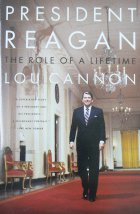
Lou Cannon, President Reagan: The Role of a Lifetime

Ronald Reagan is well known as the "Great Communicator." And there has never been any doubt that he could deliver a great speech. From his rise to national prominence with a speech for Barry Goldwater in 1968 to his debate performances against George Bush and later Jimmy Carter to his oval office speeches and Presidential addresses abroad, Reagan had a clear stage presence. And he appreciated the "role" and pageantry of the office of the President. Lou Cannon, in President Reagan: The Role of a Lifetime, helps to illumine this side of Reagan, the performer, while filling out the portrait of the man himself.

Cannon shows that Reagan saw the presidency as a series of performances, with his staff and cabinet as his supporting cast, directors and producers. He focused on executing the duties through these performances. And there can be no doubt that this was a strength for him and a boon for his presidency. He was able to communicate great visions and ideas to the American people, and to project America's greatness abroad. But Canon makes clear that Reagan wasn't just an empty performer; he was a man with vision. He harbored an ideal of how America should be, and sought to communicate that ideal and live out the narrative of that vision in his presidency.
But, in this detailed look into Reagan's life in office, Canon notes that this vision also served as a problem for Reagan, as he often had trouble seeing realities that didn't comport with his take on how things were.

In narrating the tale of Reagan's presidency and evaluating its success, Cannon points to a mixed legacy. In all, his first term was quite successful, powered by strong leadership from James Baker as chief of staff, while his second term was much less so, with much turn-over in his supporting cast and much less coherence and leadership from the people around him, and especially with the Iran-Contra debacle casting a shadow over the later years. Interestingly, Reagan's overall accomplishments were more in foreign policy than in domestic politics, though the latter was more Reagan's personal focus. His relationship with Gorbechev especially helped lead to many sucesses.

Cannon is a long-time Reagan watcher, covering him from his rise to prominence in California through his time in the White House, and his conclusions prove very telling, summing up well the tale he has told. He writes, "Reagan may not have been a great president, but he was a great American who held a compelling vision of his country." This detailed biography helps bring to life the inside story of the Reagan White House. I learned a great deal about events and people that I only faintly knew or remembered, and I'm confident that remembering the legacy left by leaders of the past can help shape our understanding of what is required for leadership in the future. Clearly Reagan is a man to be studied, with strengths to be learned from and many weaknesses to be avoided.

Thursday, September 07, 2006

Cornelius Ryan, The Longest Day


This epic account of D-Day truly portrays the scope and also the significance of this fateful day. Ryan starts by describing the situation of both Allied and Nazi troops and defenses leading up to the attacks. He follows the preparations, and also the difficult decision by Eisenhower to proceed with the attack despite less than ideal conditions. In impressive detail, Ryan both follows the large movements of troops from paratrooper drops to soldiers on the beach, while also weaving in personal details that reflect extensive research and that give a truly human element to the story.

It was especially fascinating to learn how weak the Nazi response to the attacks truly was. One wonders if things might have turned out differently if the Nazi generals hadn't been so scattered (a war game was about to be under way, and many important commanders had left their posts to take part; Rommel, the renouned General, was in Berlin instead of overseeing operatios on the coast, and Hitler wasn't even made aware of the attacks until many hours after they had commenced). Ryan takes us into the action, and helps us to appreciate the amazing scope of the operation, telling of seas filled with landing boats and skies dark with planes. It's hard to even imagine the sheer scope of the operation. A good read, and an insightful look at this most fateful day in the history of the twentieth century.

Bernstein and Woodward, All the President's Men

This summary is not available. Please click here to view the post.