Thursday, October 02, 2008

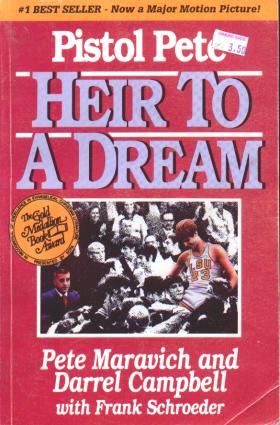
Pete Maravich and Darrel Campbell, Heir to a Dream

This little book is an autobiography (with some help) by one of college basketball's greatest players ever. Pistol Pete Maravich helped to transform the game into today's fast-paced run-and-gun style, and beyond his playmaking abilities, he was an almost unparalleled shooter. His college points records still stand. He averaged over 44 points per game in his college career, and the next closest player is still only at 34 points per game. That's domination.

But this book is about so much more than basketball. Maravich starts with his dad, recounting his discovery of basketball when it was still a young game, and his growing love for the sport, first as a player but then even more as a coach. When he had a son, it only seemed natural to teach him this same love for the game, and thus, Pete's obsession with basketball was born. He haunted the high school and college courts where his dad coached, and ultimately played for his dad at LSU, where they both shined. But Maravich recounts how his life off the court was one of recklessness and irresponsibility. He shunned the idea of being a role model, and his drinking and partying was a constant problem, even costing LSU a shot at the NIT championship when Pete stayed up the whole night before a big game partying.

Pete's despair continued as he played in the NBA, first for Atlanta, then for the New Orleans Jazz (who later moved to Utah; the name made so much more sense in Louisiana!), and last for the Boston Celtics. His whole life was basketball. He lived and breathed it, always in search of a championship. But a championship was never to be. Instead, he spent his professional career butting heads with his teammates, always seeking acceptance and adulation that never seemed to come. In the end, he walked away after the preseason of his second season with the Celtics, feeling like he wasn't getting enough playing time and appreciation--the team went on to win the championship that year.

Basketball had been pretty much all Pete knew or cared about. His marriage to Jackie, who wasn't a basketball fan, kept him grounded to at least some limited extent, but once he left the game, he realized that it had been pretty much all he had. This began an important search for him, to discover what life is really all about, because it certainly wasn't basketball. It was then, into this emptiness and helplessness, that someone spoke about Christ. Maravich came to accept Jesus into his life, and was overwhelmed by the purpose and hope that is found in realizing that you aren't the center of the universe and of discovering life's true purpose and meaning.

This simple little book made a great story about basketball, but also proves a nice refreshing reminder of the beauty and coherence and joy that come with knowing Jesus Christ. For me, it is something I too often take for granted, but it is always nice to be reminded about the joy of salvation and the peace that it brings.

Tuesday, September 23, 2008

Lee Child, The Enemy

Jack Reacher is a maverick. He is an elite Military Police officer in the Army. And on New Year's Eve, he finds himself suddenly reassigned to Fort Bird, with no explanation. The next day, he gets a call that a general, who was passing through the area on his way to a meeting at Fort Irwin, was found dead in a hotel room, apparently of a heart attack while sleeping with a prostitute. While this doesn't start off as too mysterious, hours later the General's wife is found murdered during an apparently burglary attempt at their home in Georgia. And Reacher notices that the General's briefcase is missing. His investigation starts to turn up some strange patters, like that Military Police officers all over the Army were mysteriously reassigned at the same time as Reacher. Something must be afoot. Two days later, a Delta officer, Carbone, is found dead on the base, and another Delta officer is found murdered and dumped a couple hundred miles away. Something must be going on. And seems to all stem from the briefcase.

Reacher, under some suspicion himself from the Delta troops and meeting fierce resistance from his newly appointed commanding officer, wings around the globe trying to track down this odd conspiracy, which seems to all stem from the briefcase's contents, whatever they are. The only thing that seems to be missing is the agenda for the meeting at Fort Irwin, but the General's two subordinates insist there was no agenda (which Reacher sees as a near impossibility for the Army). Reacher and his partner, Summer, are forced to sneak throughout the East Coast and even hop over to Germany on stolen travel vouchers (and officially AWOL thanks to their commanding officer) trying to bring the truth to light. It comes out the the sordid plot was part of a power play on the part of some officers from Armored Division to take out strategic elements in other branches of the Army to set themselves up as a more powerful faction in the changing landscape of the army in the new post-Cold War world (the book, written in 2004, takes place in 1990). General Kramer was involved in a homosexual affair with Carbone, and when he died of a heart attack, Carbone apparently discovered the agenda for the Irwin meeting, which involved the plot to kill Delta soldiers among others. Carbone took the agenda, and called his commanding officer (thus, they were the two Delta soldiers killed by Kramer's subordinates, try to cover up the meeting's agenda). Kramer's wife was also collateral damage, as they were searching his house for his briefcase when it wasn't found with the body.

Child's book is a relatively good read, and the mystery certainly proved to be a complicated and sordid plot that I wouldn't have guessed at the outset, even if it proves to be quite far-fetched. The biggest flaw in my opinion has to do with the main character, Reacher. He makes an interesting protagonist, with his maverick ways and his desire to get to the bottom of things at all costs. But he proves to be unscrupulous and vindictive to a fault. He flouts authority, and, most damningly, coldly executes his superior officer at the end of the book, believing him to have been part of the plot. Tom Clancy's Jack Ryan makes such a great main character because of his honor, his "boy scout" character, that means doing the right thing even when it means trouble for himself, always believing right would win out, even when it seemed improbable. Reacher is quite a contrast, doing whatever it takes to get the outcomes he wants.

Tuesday, September 16, 2008

Ray Bradbury, Farenheit 451

In Ray Bradbury's classic, Farenheit 451, he describes a terrifying but all-too-real world of sensory overload and thought-depravity. Guy Montag is a fireman, but this fire brigade doesn't put out fires (for houses are fire proofed with plastic coatings), but instead starts them, burning houses (and often people) where books are found. And people, for the most part, don't question the way of things; in fact, most people simply contributed to them, reading less and less, being less and less interested in dissenting views and complex views of reality. Instead people opt for graphic novels filled with sex, and talking "parlors," living rooms with televisions on three (and sometimes four) walls that surround the viewer in a virtual reality that becomes family, friends, entertainment, and knowledge. There is no taking walks, no late evening chats on the front porch; in short, little or no thought. But Guy slowly emerges from the haze of this contrived reality, as he first encounters a strange girl who doesn't seem to be charmed by the way things are, and then comes to see his own duties as a fireman as brutal and senseless. Didn't firemen used to actually put out fires? he wonders.

Montag, now repulsed by his occupation, starts looking for a way out. And on the way, he begins slipping books into his coat as he is burning houses, one here, one there, until he's got his own little library. But soon his captain, Beatty, is on to him, and the mechanical hound, the instrument of doom and seeker of people and books, finds him out. Montag is left with the choice, burn his own house or admit guilt. He starts his house ablaze, but then turns the flame thrower on Beatty and on the mechanical hound and makes a break for it. He is now a man on the run, but a free man for the first time. He finds himself among a group of run-aways along a deserted railroad track, and discovers they are former professors and preachers, and each one holds inside him a chapter or a book. One is Thoreau, one is Marcus Aurelius, one is Plato's Repulic, and so on. Montag is the book of Ecclesiastes. And as their civilization seems to be spiraling toward an end in a huge and destructive war, the wisdom of that great book, that everything has a time and a season, seems a pointer to the possibility of a new reality, a fresh start.

Bradbury's Farenheit 451 is a prophetic novel that bears freightening resemblance to our world today. Our culture resembles the reality he paints in its obsession with virtual reality (think "reality TV" and our obsession with this fictive family or friend network, as just one examle), media saturation, and shallowness. Our politics are driven by sound bites and media experts more than they are driven by policy positions and reasoned debates. Marketing is more important than product quality. And this is just the beginning. Reading Bradbury's classic is like a wake-up call to appreciate the wisdom of the ages, the beauty of friendships, the value of family, and the wonder that is a quiet walk in the woods. It is truly a treasure trove of reality, all tinged with the hope redemption.

Thursday, September 11, 2008

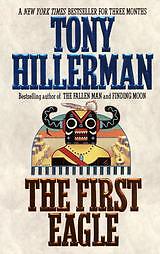
Tony Hillerman, The First Eagle

I have long been a lover of Tony Hillerman stories. I enjoy the cultural landscape that surrounds his mysteries, and appreciate the cultural tensions in which his characters struggle and flourish. This book displays that same depth with the same quality mystery that typifies Hillerman's work. Now, his writing is as deep as P. D. James, but that's okay. Jim Chee and Joe Leaphorn are two good main characters, and they again put their detecting skills to work to solve a murder and a disappearance. Chee is a Lieutenant with the Navajo Tribal Police and Leaphorn is a recently reteired Lieutenant. These long time partners find themselves working on the same case, with Chee investigating the murder of fellow Tribal Officer Kinsman while Leaphorn is working as a PI to investigate the mysterious disappearance, around the same time and place as the murder, of a vector control officer studying a recent case of Bubonic Plague.

Chee was the first one on the scene of Kinsman's murder, and captured a suspect literally "red handed." But his former fiance and defense attorney for the accused, Janet Pete, insists that there's more than meets the eye. The mystery takes the two all across the desert southwest, and into the world of vector control and research into contagious disease. As they figure out that Cathy Pollard has disappeared in the same vicinity and at the same time as the murder, they must figure out if and how the two events are related. Is she a suspect? Another victim? An unrelated disappearance.

This book is vintage Hillerman, and I enjoyed it. It made me yearn for the southwest, and if gas wasn't so expensive I'd hit the road for Santa Fe or Albuquerque to take in some sopapillas and some desert scenery.

Wednesday, September 10, 2008

Brad Meltzer, The First Council

White House lawyer Michael Garrick finds himself going out with the first daugher, Nora Hartson. A thrill-seeking and irresistable twenty-something, she proves to be an interesting date. After losing their secret-service escort, Nora and Michael find themselves in a shady bar in the heart of urban DC, where they witness the head White House lawyer, Simon, make a clandestine meet, and after following him, discover he has dropped off a large quantity of cash. The two suspect some shady dealings, but things quickly pick up momentum. The next morning, Michael discovers that Simon has accused Michael of being the one who had the money. This strange turn leads to many more, as suspicion quickly turns to Michael, and also to Nora, as their relationship meanwhile continues to deepen. The book chronicles a high-stakes chase across DC as Michael works to find out what that money was all about, and to keep himself out of the line of fire and out of the papers. The twists keep coming in this devilish power struggle, as Michael tries to defend his honor and protect the first daughter. The resolution is a bit of a twist, as things all come crashing down through the ceiling of the Indian Treaty Room of the Old Executive Office building.

Meltzer's book makes for a good fast-paced read (or, in my case listen). While not entirely plausible as far as the actual inner workings of the government at the highest levels like a Clancy, or the grand legal thriller of a Grisham, it weaves elements of both together in a fun little tale of intrigue.

Thursday, August 28, 2008

John Grisham, Playing for Pizza

In Playing for Pizza, Grisham returns to the genre of literature he explored in his earlier book, Bleachers. Like that book, football provides the backdrop. In this delightful little book, Rick Dockery, a struggling NFL quarterback near the end of his short and abortive career finds himeslf heading off to Italy to play American Football after a disastrous performance in a big playoff game for the Cleveland Browns (he was the third string quarterback, and came in after a couple injuries and threw away a big lead with three interceptions).

Dockery, even though he is pretty low on the NFL totem pole, and now even lower by blowing the big game, is still a pretty big shot in the sports world, being an NFL quarterback. He's used to finding places to play, people that want him on their team, all while waiting for his big break into the big time. His career is the big goal. But that vision slowly erodes away on him as he finds himself with no offers to play. His agent finally finds him this spot in the very obscure league in Italy and convinces Dockery to take it. Needless to say, it's a big change, playing in a converted rugby stadium, often in front of less than one thousand fans. But the Italians are excited to have him. The Parma team hasn't ever won the "Super Bowl" of Italy, and sorely wants to. Each team is allowed three American players, but during the course of the short season, the other two Americans for the Parma team leave, and Rick is left to make the best of the season. His performances have been pretty good, but he will need to step it up, as will the whole team, to win the Super Bowl.

Rick meets an American girl, Lilly, who is in Italy studying art and avoiding her familiy, and the two of them take up together. Rick is forced to explore the country with her, and also forced to open up to another human being.

Turning down an offer to return to Canada to play pro ball, Rick buckles down and diligently works with Sam to come up with a plan for a winning season. And his performances continue to improve. He goes from treating the Parma Panthers as the small time to putting all his energy behind his team, and it makes a big difference for the team, and for him. A trimphant Super Bowl win caps his transformation on and off the field, and we are with Rick planning to stay on in Italy for another year, content with where he is at.

Thought this book is a departure from Grisham's usual thrillers, it has the stamp of his quality pacing and interesting characters. His colorful pictures of Italy provide a great backdrop for this nice little tale of a troubled kid who explores the world outside his glitzy and self-centered NFL life. It's a great read and makes me want to spend a month in the Italian countryside. Someday.

Wednesday, August 27, 2008

Mark Twain, Tom Sawyer

In the spirit of summer, I recently reread Twain's classic tale of childhood, Tom Sawyer. The classic episodes like Tom convincing friends to pay him for the privilege of whitewashing his aunt's fence to showing up at his own funeral to being trapped in a cave truly convey the joy and adventure of childhood. From one idea to the next, Tom's world of dreams and his superstitious and clearly warped sense of reality make for great entertainment. And of course, the witnessing of murder, the pursuit of treasure, the honorable exoneration of an innocent man, the chase by Indian Joe, and the triumphant discovery of hidden treasure make for quite a plot. It's hard to imagine better summer reading. If you haven't picked up this book for a while, give it a shot. You'll remember why it is truly a classic.

William P. Young, The Shack

I've been very slow posting since we just finished moving and have been getting settled, but I'm finally trying to catch up on some books I've finished recently. The first is The Shack. This book has become quite well known, and I dare say notorious, over the past weeks, and there's been a lot of discussion on the Web about it: it's theological underpinnings, it's quality as literature, etc. Because it has been so much talked about, I won't either summarize the plot or give a detailed theological critique. Both of those things have been undertaken elsewhere. What I will do, though, is give a brief appreciation of this great little book.

I think Young has written a powerful and imaginative tale dealing with important questions many Christians wrestle with, especially concerning justice and suffering. I love his imaginative portrayal of the Trinity as Papa, Jesus, and Sarayu. Though I think what has been said elsewhere does ring true: this isn't a systematic theology text, it is fiction, so it shouldn't be expected to fully and completely flesh out the doctrine of the Trinity. But I think it does illumine one great element of it: the tri-personal nature of God and the beauty of the interrelation between the persons. God's unity may get a little neglect in this portrayal, but I think that is okay, especially because modern Christians seem to have no problem with the oneness of God, but often neglect the Trinitarian tri-personality. That said, I also think the main thrust of the book is spectacular in it's power to confront the reader with the deep questions of suffering, tragedy, and trust. I know for me, it was especially convicting to be reminded that it was only in believing that God is really good that I could really trust him. The insight seems so simple, but its presentation made it profound.

In all, I do highly recommend this little book. It's certainly not perfect, but I am convinced that it can be a powerful story of God's love and grace. And, hopefully it will insight curiosity and interest in the deeper theological issues it touches on.