Saturday, June 28, 2008

I Want to Believe, Mel Lawrenz

Mel Lawrenz is pastor of Elmbrook Church in Brookfield, Wisconsin (thanks to Elmbrook Church and Pastor Lawrenz for the review copy; HT: Scot McKnight for spreading word of the offer). In I Want to Believe, Lawrenz sets out to offer a guide for belief in God in our pluralistic and agnostic age. This involves some basic and careful apologetics, some study of comparative religions, and some great pastoral reflections on the nature and content of the Christian faith.

The basic premise that Lawrenz starts with is that we all have a need for God. For Lawrenz, we are "born believers. It's just simply how we're made" (8). God created us for relationship with him, and it shows in how we're made and how we experience the world. As humans, we feel mortal (and why shouldn't we, Lawrenz points out, because we are), and we look for structure and meaning in life. This doesn't mean belief is easy, but in some way it is "natural" (my word, not his). He writes, "Believeing in God is not like a scientist trapping an animal in a cage to bring back to the laboratory for further study and tests. . . . God caries us away" (17). Later, he illumines the fact that belief goes beyond understanding, and that's okay. Because belif is where "the Made and the Eternal" are conjoined, and if we come to a point where we fully understood it, then belief would be about us and what we do. But it's not; it's about God.

Throughout the rest of the book, Lawrenz does a very fine, pastoral job of working out what it means to believe, as humans, as citizens of a pluralistic world, and finally, as followers of Jesus Christ. This involves discussions of doubt (a chapter worth the price of the book), atheism, Islam, and the specifics of the Christian faith, to name a few of the topics he brings in.

Lawrenz book might be termed apologetics-lite, in a sense, but that is meant in the best possible way. He doesn't get bogged down in philosophy or argumentation but instead helpfully touches on many of these themes but moves beyond them to God and what it means to be in relationship with him. I think this great little book makes a user-friendly introduction to belief in the modern world, and I wouldn't hesitate to hand it to someone searching for faith, or even decidedly not searching for it.

The Nature of the Atonement, Bielby and Eddy

I'm finally getting around to the pile of books I've finished but not commented on over the last few months. In The Nature of the Atonement: Four Views, four scholars are asked to put forth a comprehensive understanding of what they consider to be the foundational metaphor or central thrust of the New Testament's teaching on atonement. They are then asked to interact with each of the other three author's views, facilitating a dialog between the different views and accentuating both commonalities and disagreements. The four scholars and views are as follows:

Gregory Boyd, Christus Victor
Joel B. Green, Kaleidoscopic
Bruce Reichenbach, Healing
Thomsa Schreiner, Penal Substutition

Because of the nature of the book, that is, that each scholar is already abridging an in-depth discussion in their short essays and that each scholar interacts with the others, I will simply restrict my review to some brief comments of evaluation and commendation.

In most evangelical circles, it would seem that the penal substitution view holds sway as the dominant (and sometimes almost the only) view. And Thomas Schreiner does an admirable job of displaying the deep scriptural roots and theological reasoning that make this such an important view. Greg Boyd, in what was maybe for me one of the strongest pieces, displayed the deep scriptural roots of the Christus victor model, showing the importance of victory of death and evil for biblical thinking about sin and salvation. Bruce Reichenbach ably deploys arguments for the healing aspects of atonement, emphasizing forgiveness and reconciliation as part of this understanding. Joel Green's essay was also very strong, emphasizing that the context of Jesus' death and the purposes of God are two essential aspects of thinking about the atonement. This leads him to assert that no one metaphor or model will fully illumine the significance of Christ's death, nor will any one model necessarily be the best way to speak the truth of Christ's death into our cultural setting today.

Each author does their view justice, in showing the deep logic that underpins it and the way the atonement fits within a larger Scriptural and theological framework. Each author also sets out to show how their view sets the foundation for or interacts with other views and metaphors, which make up subsidiary ways of speaking about Christ's death. For this reason, I think this book makes a great entry point into this lively and important dialog about the work of Christ and the nature of the atonement. It deals deliberately with the text of the New Testament and also, in less depth, with the historical interpretations and understandings of Christ and his death.

Sunday, June 15, 2008

Elie Wiesel, Night

I have just finished rereading this powerful and haunting narrative of Elie Wiesel's experience as a Jew experiencing the Holocaust and the famed Auschwitz concentration camp in Poland. I first encountered this little book in a seminary class on God, Evil, and Suffering, and it was a fitting way to begin that class. For in it, Wiesel thoughtfully reflects on the dept of the depravity he witnessed in years of German maltreatment.

He begins the story with the the waiting and questioning of 1943. His thoughts and that of his community were both on Hitler's progress and prospects, and also on God's existence and benevolence. The year 1944 brought all these things to a head, as the Jews were first placed in a Ghetto and then moved out to concentration camps, both surreal experiences of coming to realize the extremity of their situation. Some hope of humanity remained, either as only wishful thinking or as common-sense expectation that things couldn't be as bad as some thought, but with the arrival at a German concentration camp, with separation by men and women and then by age and ability, with some going to work and others going to the crematories, reality, unexpected and unimaginable as it may have been, began to set in. The horrors daily experienced by Wiesel and his fellow prisoners are still hard to imagine, but that is why they are so important to read.

One episode at Auschwitz stands out as a climax of inhumanity: the hanging of a young boy who had been an assistant to an Oberkampo, a prisoner who was in charge of other prisoners. The boy refused to speak about allegations against his Oberkampo, so the Germans sentenced him to death. Wiesel recounts the lilence throughout the camp as the hild was hung. "Where is God? Where is He?" The question rung out behind Wiesel as he watched the events. Then, as the prisoners were all forced to march by the hanging prisoners, including the yong boy who was still hanging alive in the last momets of life (too light to have his neck break immediately upon hanging). "where is God now?" the question again is asked. It is impossible for questions like that to ring in our minds. Wiesel continues his reflection on these horrors, and upon God. This turned him to anger: "What does Your greatness mean, Lord of the Universe, in the face of all this weakness, this decomposition, and this decay?" (73-74). God becomes the accused, but along with this comes a great void. It is that void that rings throughout the whole work.

While not easy to read, this Holocaust memoir is essential reading. It is important that we remember. We must acknowledge the depths to which our inhumanity can go. We live in a world of suffering and death, and to picture it with rose colored glasses doesn't make it go away. Instead, acknowledging and living in the suffering of others gives us a chance to begin walking along side them. It's also a reminder that easy answers won't suffice. That isn't to say that the void Wiesel speaks of and evidences are the true state of affairs in our world, but that they are important experiences into which God's truth must be spoken.

Thursday, May 08, 2008

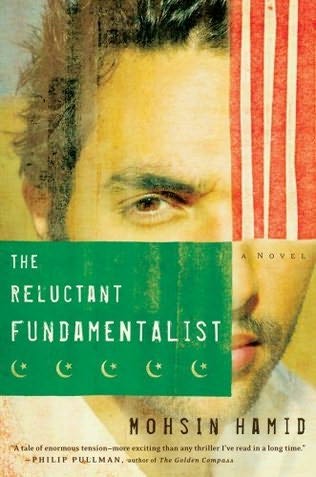
Mohsin Hamid, The Reluctant Fundadmentalist

The Reluctant Fundadmentalist is a short novel about a Pakistani's experience in America around the time of the 9/11 attacks. It begins in a market in Lahore, Pakistan, where the main character, Changez, a native Pakistani, helps an American find a table and enjoy some of the delicacies of Pakistan. The novel chronicles their long conversation, as Changez talks of his experiences in going to America to study at Princeton, his success there and his sought-after job at Underwood Sampson, a valuation company. Changez finds himself a top prospect at this elite American company, traveling all over the world in its financial endeavors. He also courts an American girl, Erica. But September 11 happens, and he finds his world start to change. From his own initial reaction of delight at the symbolism of America and the West being brought to its knees to his own impressions of the world as it changes around him. He becomes a living contradiction, both part of the American financial system and also resentful of it. At the same time, his relationship with Erica takes some unsucessful turns, as he discovers she is caught up in lost love for her high-school boyfriend, who died tragically. And there relationship goes nowhere, as Erica becomes increasingly distant and overtaken by mental instability. Finally, the contradictions overtake him, and he can't stand to be part of the system he finds so horrible, supporting the country he finds to be such a meddler in the affairs of the world. So he leaves his job in the middle of a project and heads back to Pakistan. The book closes as he finishes his evening drinks with the American, and then proceeds to lead him into a trap, where he will be captured, or worse.

Hamid's novel is clearly at least somewhat autobiographical, as he himself is from Lahore, and spent time studying in America. It shows penetrating observation into the culture of America, with some interesting analysis of how it shifted with September 11. This little novel proved to be a very interesting read, and is a helpful window from the outside, in a sense, on American culture.

Saturday, April 19, 2008

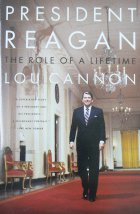
Lou Cannon, President Reagan: The Role of a Lifetime

Ronald Reagan is well known as the "Great Communicator." And there has never been any doubt that he could deliver a great speech. From his rise to national prominence with a speech for Barry Goldwater in 1968 to his debate performances against George Bush and later Jimmy Carter to his oval office speeches and Presidential addresses abroad, Reagan had a clear stage presence. And he appreciated the "role" and pageantry of the office of the President. Lou Cannon, in President Reagan: The Role of a Lifetime, helps to illumine this side of Reagan, the performer, while filling out the portrait of the man himself.

Cannon shows that Reagan saw the presidency as a series of performances, with his staff and cabinet as his supporting cast, directors and producers. He focused on executing the duties through these performances. And there can be no doubt that this was a strength for him and a boon for his presidency. He was able to communicate great visions and ideas to the American people, and to project America's greatness abroad. But Canon makes clear that Reagan wasn't just an empty performer; he was a man with vision. He harbored an ideal of how America should be, and sought to communicate that ideal and live out the narrative of that vision in his presidency.
But, in this detailed look into Reagan's life in office, Canon notes that this vision also served as a problem for Reagan, as he often had trouble seeing realities that didn't comport with his take on how things were.

In narrating the tale of Reagan's presidency and evaluating its success, Cannon points to a mixed legacy. In all, his first term was quite successful, powered by strong leadership from James Baker as chief of staff, while his second term was much less so, with much turn-over in his supporting cast and much less coherence and leadership from the people around him, and especially with the Iran-Contra debacle casting a shadow over the later years. Interestingly, Reagan's overall accomplishments were more in foreign policy than in domestic politics, though the latter was more Reagan's personal focus. His relationship with Gorbechev especially helped lead to many sucesses.

Cannon is a long-time Reagan watcher, covering him from his rise to prominence in California through his time in the White House, and his conclusions prove very telling, summing up well the tale he has told. He writes, "Reagan may not have been a great president, but he was a great American who held a compelling vision of his country." This detailed biography helps bring to life the inside story of the Reagan White House. I learned a great deal about events and people that I only faintly knew or remembered, and I'm confident that remembering the legacy left by leaders of the past can help shape our understanding of what is required for leadership in the future. Clearly Reagan is a man to be studied, with strengths to be learned from and many weaknesses to be avoided.

Friday, March 21, 2008

Mark Noll, The Civil War as a Theological Crisis

The Civil War as a Theological Crisis is The Steven and Janice Brose Lectures in the Civil War Era, delivered at the University of North Carolina, and as a book that came out of a series of lectures, it has a relatively conversational and approachable tone. Mark Noll is an eminent historian of Christianity and specifically evangelicalism in America. In these lectures, Noll looks at the theological issues, which Noll argues in fact constituted a theological crisis, that shaped the Civil War and informed the views of politicians and the populace on both sides of the conflict. Noll begins by setting the stage with a look at the role of religion in American public life in the years leading up to the War, and especially at the role the Bible and its interpretation played. He then looks closely at "The Crisis over the Bible," the differing interpretations of various passages in the Bible, especially over the issue of slavery, that contributed so profoundly to the theological divide in the country. This chapter forms the core of the book, as he looks at competing interpretations of the Bible and the methods and assumptions that led to these conflicting interpretations. This then leads to a discussion of "the negro question," a look at the role race played in the discussions, either implicitly or explicitly. He shows that at the root, deep-seeded racism lay behind many of the defenses of slavery, and ignorance of the importance of the race issue weakened many of the opponents' arguments. It is crystal clear that the Civil War was a war with race issues at the center, though Noll emphasizes equally strongly that the picture is far more complex than a simple bifurcation of the country with the North fighting some type of righteous struggle on behalf of equality and the South fighting a bigoted battle to preserve the status quo.

Noll's discussion then turns to a look at what role providence played in the preaching and thinking about America's destiny and the racism and slavery that were at issue. He writes that "confidence in the human ability to fathom God's providential actions rose to new heights." Many on both side presumed to know God's will and intention in and for America. By the end of the war, this view was strongly chastened, and Noll points to a connection between arguments concerning providence before and during the war and the movement of religion to the "private" sphere after the war. After these substantive discussions, Noll takes an informative look at views of Protestants and Catholics abroad, and takes stock of these perspectives that give a different view point on the happenings in America.

I found Noll's book to be compelling and important reading. I think his careful appraisal of this important conflict over the role and interpretation of the Bible needs to inform evangelical approaches to Scripture today. I think one of the clearest lessons needs to be a chastening of our American and Protestant impulse to read and interpret the Bible on our own, without recourse to church or magisterium, and often without regard for history. Along with this goes a strong warning against assumptions of the simplicity of the Bible's message. Throughout the era leading up to and including the Civil War, defenses of slavery had an easier time convincing much of the American public, often largely because of the simplicity of its arguments and the fact that it drew on "plain" and surface readings of the Biblical text. Readings that opposed slavery often incorporated more nuanced and historically couched arguments. For many, this went against their protestant and American sensibilities and assumptions.

It would seem that this book, and this historic situation, has much to say to our modern-day church, and to the evangelical church in particular. Issues such as the church's stance on women in ministry or the status of homosexuals can be well informed by this discussion. That is certainly not to say that the historic move to condemn slavery should or could be directly applied to the acceptance of women in ministry or the full acceptance of homosexual activity, but this careful historical discussion provides some important context in which to judge our approaches to Scripture. It also rightly calls us to examine our assumptions that we bring to the Bible. I highly recommend it.

Thursday, March 20, 2008

Jeffrey Toobin, The Nine


Jeffrey Toobin's The Nine is an inside look at the US Supreme Court. Toobin takes a careful look at the justices and the decisions that have shaped the court over the past ten or so years. He goes back to the impeachment proceedings against Clinton, looks at the Court's inner deliberations and dynamics in the Bush v. Gore decision, and looks at how the personalities and philosophies have molded the decisions coming out of the high court.
Toobin looks at each justice individually, starting with their rise to the court and also detailing their time on the court and their legal logic. Toobin then takes his account up through the stability of the Rehnquist court (which he says should better be called the O'Connor court because of her status as the perpetual swing vote deciding many of the most important cases) to the two new justices confirmed during the (George W.) Bush presidency.

Toobin's book is a great read, and makes a great primer for what the Supreme Court is all about and what decisions have been landmarks over the past decades. He has chronicled the liberalizing tendencies of the court through the nineties and into the new millenium, and the new conservative shift with the appointments of Roberts and Alito. The book is a good occasion to reflect on judicial philosophy, and certainly made me rethink how the decisions of the supreme court impact our daily lives. I highly recommend this book, and hope you enjoy it as I did.

Tuesday, March 04, 2008

Robin Cook, Crisis

Crisis is another in a long line of medical thrillers from author Robin Cook. I have enjoyed many of his previous books, and this one lived up to the same standard. Favorite characters Jack Stapleton and Laurie Montgomery resurface again. Jack is a medical examiner in New York City. When he learns that his sister's husband is being tried for medical malpractice up in Boston, he heeds his sister's call for help when the trial doesn't seem to be going well and comes up to Boston. His brother-in-law, Craig Bowman, is on trial for the death of Patience Stanhope, a "problem patient" of his who died of a heart attack. The plaintiff's case is that Craig didn't respond to the threat of a heart attack with proper speed, and instead of sending Patience straight to the hospital, he made a house call, delaying her care. The motive for this house call was alleged to be that Craig wanted to make the start of the symphony concert that evening to show off his mistress, and could only do so if he made a quick stop by the house on the way to the concert. It turned out that Patience was in very serious condition, and after being rushed to the hospital she died a bit later.

Once he arrived, Jack suggested that he may be able to help by conducting an autopsy of the deceased patient, in hopes of finding some major pathology that would prove that the delay had no bearing on the patient's death, or that some other factors mitigated against medical malpractice. So he began the process of exhuming the body, first needing permission from the husband (and plaintiff in the case), and once that was secured, needing to arrange for the exhumation and autopsy to happen quickly. Along the way, he was met with much opposition, mostly in the form of intimidation from Franco, the plaintiff lawyer's rather dubious sidekick. But Jack pressed on, and finally, on the evening before the last day of the trial, he was able to conduct an autopsy. But what he found surprised him. There was no pathology suggesting heart disease, and neither was there any type of pathology indicating why the patient had declined so quickly. This created quite a mystery, but one that was finally solved by toxicology. A potent poison was found in her system that causes failure of the sodium channels of all muscles, and thus, major problems with the heart. This proved especially interesting because the poison in question is a highly controlled substance, but also a chemical that Craig himself used extensively in research. It turned out that upon inspection, traces of it were found in Craig's medical bag. He had murdered his "problem patient," much to Jack's dismay. But this evidence was turned over to the judge, who dismissed the medical malpractice case and forwarded the evidence to the district attorney for criminal charges.

Crisis is another good medical thriller from Robin Cook. There were some interesting plot twists, though the characters (and especially the villains) seemed a bit stylized, though in this case that proved to be good misdirection, as they were not ultimately behind the wrongdoing. Crisis is worth the read (or as in my case, the listen), and is a good, fast paced, and engaging mystery.