Wednesday, March 17, 2010

David Murrow, The Map: The Way of All Great Men

Thanks to Thomas Nelson for the review copy. In The Map, David Murrow, the author of Why Men Hate Going to Church, uses the metaphor of a map, along with a creatively told fictional tale of its discovery, to describe the spiritual journey of a man. He begins with a ten-chapter tale of the map's discovery in an ancient manuscript in a Grecian monastery by the monk Gerasimos, and of his own involvement in the project as a journalist and writer who could popularize the discovery. But things aren't so simple when he discovers he is being pursued by a mysterious group with unclear motives. Someone must want the map for personal gain. David goes to the monastery to meet with Gerasimos, and he is taught by the monk about the journey the map describes. He is then finally introduced to the map.

The map itself, described in an ancient document entitled "The Three Journeys of Jesus," is actually a key to understanding Jesus own life as depicted in the Gospel of Matthew as three journeys, submission, strength, and sacrifice—three journeys that all men are to emulate in a life of discipleship.

In the second half of the book, following on this interesting fictional account, Murrow fleshes out these three journeys he finds in Matthew's gospel. The first, submission, is found in the early part of the Gospel (chs 1–7). It entails a journey toward the feminine, and is characterized by submission to God. The second is strength, and is found in Matthew 8–25. It is a journey of assertion and strength, a journey toward the masculine. The final journey is sacrifice (Matt 26–28), a journey back in the feminine direction, focused on handing over control, passing on responsibility, training up the next generation.

I found much of value in Murrow's creatively shaped handbook on male discipleship. I think he has indeed picked up three important themes of discipleship and described them well. His assertion that he has found a hidden map in the Gospel of Matthew is more tenuous, I would think, though that doesn't totally undermine the key insights. I also found his description of these stages or journeys in terms of masculine and feminine as a mixed bag. In some senses, it is helpful to see how these stages relate to typical tendencies or traits aligned with one gender, and to warn of the pitfalls that might be typical of especially men, means it has its use. Though in a more absolute way I don't think they were necessary for the book's key insight. In terms of a book directed toward men, and the vision of male discipleship it forms, I think Murrow's book has much value. It is a helpful corrective to some male-directed books that seem to glorify masculine traits and tendencies at the expense of important biblical themes like submission and sacrifice. So there is no doubt the book has great value for that alone.

In all, I found a few points on which to quibble, but I clearly think Murrow has identified three important themes in the life of the disciple, packaged them creatively with a fictional tale and a helpful map, and directed them well to a male audience. I hope this book is read widely and that it engenders a dialogue about the shape and purpose of the Christian life, especially the Christian life of a man.

Friday, February 19, 2010

Stephen Mansfield, The Search for God and Guinness

Thanks to Thomas Nelson for the review copy. This book is, as its subtitle proclaims, "a biography" of a beer. But, it is obviously more than that. In short, it is the biography of a family and a company whose history is seasoned with devotion to Jesus Christ and to the conviction that faith can be lived out beyond the walls of a church. In this interesting and readable journey through 250 years of history, Mansfield writes an engaging chronicle of how this family's faith shaped the ethos of a company and led it to be a leader both in the quality of the product it produced and in the way it formed a corporate culture. I can't say I'd ever thought of beer as a particularly healthy drink (probably due to a lot of baggage that often comes with the beverage in its American context), but its value as a safe and wholesome alternative to either unsafe water or to harder liquor in the early years of the company was part of the motivation behind its beginnings.

I was fascinated by the way this company continually chose to be a leader in the way it treated its workers, from the way company doctors aggressively sought to improve the living conditions of turn-of-the-twentieth-century workers, to the preservation of jobs for people in military service during the second world war, to the high wages it paid. I was also intrigued by the pattern of heirs apparent sidestepping their path to the company for full-time Christian ministry.

In all, this was both an entertaining and informative study on how one family and company have lived out their faith. It certainly gives food for thought on how our corporate culture today often falls short.

Saturday, February 06, 2010

John Grisham, The Summons

In this 2002 return to Clanton, Mississippi, Grisham takes a bit of a departure from his more typical legal-thriller style. Ray Atlee, a law professor from Virginia, gets a rather cryptic "summons" from his ailing retired-judge father regarding the disposition of his estate. Ray arrives to find his father dead on the couch, and he soon discovers boxes and boxes of cash in the study cabinets. So Ray is set on a mission to figure out where all this cash came from (some shady dealings by his father?), and what to do with it (divide it with his in-and-out-of-rehab brother, declare it to the government?). The action picks up as Ray discovers that someone else must know about the cash too, as they stalk around the house, and later break into his Virginia apartment. Though not Grisham's best work (that's a pretty high standard), I still really enjoyed this book. The writing is good, the characters and setting interesting, and the mystery agreeably opaque.

Friday, February 05, 2010

Dietrich Bonhoeffer, Life Together

I highly recommend this classic work on the importance of Christian community. Coming out of his experiences in the Confessing Church seminary in the years leading up to WWII, Bonhoeffer's spectacular book both outlines the theological foundation for a robust and intentional communal life, but also gives practical advice on how to bring it about. While we certainly won't all be participating in the daily type of community that Bonhoeffer envisions (though it is very different from a cloister life, in that it is intentionally pointed toward and among the world in service), his vision is filled with great wisdom and insight for appreciating and reinvigorating our participation in our churches and smaller fellowship groups today. Teaching about Bible reading, prayer, service, and confession, Bonhoeffer paints a picture of the Christian life that preserves one from self-absorption and brings one into the support and fellowship of the communion of saints as we encounter Christ in one another. Truly a must-read.

W. Dale Cramer, Levi's Will

Thanks to Bethany House Publishers for the review copy. In Levi's Will, Cramer brings the modern-day Amish community to life. He crafts a powerful story of a son, Will, who leaves the Amish community of his birth under a cloud of disgrace to find his way in the world. Eventually he reestablishes contact with his family, but his reception is mostly cold, especially from his father, Levi, who considers Will to be under the ban imposed on him for his youthful waywardness. As the years go by, and he is embroiled in a complicated relationship with his own son, does he begin to see his father's actions mirrored in his own. Over many years, Will is brought back into the fellowship of the family, and receives absolution of sorts from his father. A forgiveness that likewise brings him back to God as well.

This is a well-written book that explores the imperfections in a father's relationship with his son, and how those can sometimes be unwittingly passed on to subsequent generations. But it is also a story of forgiveness, both withheld and granted. And it becomes even more powerful when you read the author's 2009 Afterword to the book (originally published in 2005), which tells of how the book is a relatively close parallel to the experience of the author's own father. Or, at least, it was except for the ending. He hadn't experienced the the same reconciliation, and was still under a ban and outside the fellowship of his sister's Old Order Amish family. But after the publication of the book, he was encouraged by his sister's children to write an appeal to the bishop asking forgiveness for the sins of his youth, a forgiveness which he eventually received. So the (real) story ends with a happy reunion of long-estranged family. As Cramer summarizes it, "Only God can get away with an ending like that" (396).

Wednesday, February 03, 2010

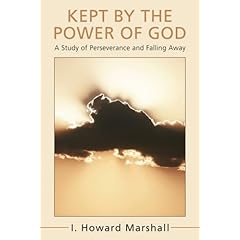
I. Howard Marshall, Kept by the Power of God

In this classic study (published originally in 1969 and republished with a new substantive epilogue in 1995), Marshall looks at a key theological issue in the New Testament, the perseverance of believers. In a setting of persecution, the question of perseverance is one that arises often in the NT texts, and it is an important pastoral issue still today. But it is also extremely useful as a lens through which to view the NT understanding of salvation, election, judgment, and many other interconnected ideas. In short, it is a vital test case, or maybe better put, it is essential data for a robust NT doctrine of God and of salvation.

Marshall digs in to the relevant NT texts by first investigating the OT and Jewish background concerning perseverance. He then moves through the various corpora in the NT: the Synoptics, Acts, Paul, Pastorals (may or may not be by Paul, but treated separately from though with an eye toward the undisputed Pauline corpus), Hebrews, the Catholics, and the Johannine literature. This systematic study is largely exegetical, as Marshall works carefully with the individual texts on their own before summing up each author's perspective.

Marshall then brings all of this data to bear on a conclusion: "We can say firmly that, while it is possible for a Christian to fail to persevere after a genuine experience of salvation, yet, with all the promises of a faithful God to sustain those who trust in Him, the main emphasis of the New Testament is on confidence and assurance of final salvation" (210). In short, while we can't explain away the possibility of falling away, believers may be "confident of persevering through the power of God" (199).

I am greatly appreciative of Marshall's study. I think it is a wonderful exegetical survey of this important area. And I think it provides an important testimony to the work of God in salvation. It obviously has much bearing on the Calvinist-Arminian debate (though Marshall prefers the designation "non-Calvinist" in this context because the second position isn't necessarily in conformity with Arminius). He has many insightful discussions of election, calling, monergism vs synergism, and some of the other relevant theological areas that are touched on by this topic. I greatly benefited from this book, and think Marshall has taken a robust, biblical line on the question of perseverance and, more broadly, on God's working in salvation.

Wednesday, January 20, 2010

Sahah Palin, Going Rogue: An American Life

I departed a bit from my usual routine to read the much-publicized autobiography of Sarah Palin. She was an interesting character, to say the least, in the 2008 elections, and this book gave her own interesting perspective on those events.

I usually enjoy biographies, and this one was no different. She details her own upbringing in Alaska, her experiences as a wife and mother, Todd's job on the North Slope, and her own political development. There were a number of fun stories that give a window on life in the great frontier of Alaska. But the book really hits its step when it gets into her political career, from her somewhat surprise foray into politics as a councilwoman to her election as mayor, and on to the Governor's office, bucking the party the whole way. She certainly paints herself as a maverick, and her record would seem to fit the bill. She stood up to corruption in both parties in Alaska and sought common-sense solutions to problems. Her straight-talking political style and her advocacy of a common-sense convservatism make her an interesting character, and she certainly comes off as something other than your usual politician.

Her account of the 2008 presidential campaing was the centerpoint of the book, and it gave an interesting perspective to her role. The McCain campaign came off, in her characterization, as being poorly managed, as as often mismanaging Palin, especially when it comes to her own responses to her critics. So this book was a chance for her to say what she wanted to say at the time. And in that vain, it seemed to fit some of the pieces of her involvement in that campaign and her characterization in the media together. In all, it seems she might have proved to be a better candidate than she did if she'd been allowed to speak more freely. But that's all in hindsight, of course.

In all, this was an interesting, and well-written book, and Palin certainly comes off as a legitimate political force giving voice to a clear current within American political thinking. Maybe she isn't presidential material (that jury is still out, I'm sure), but there is no doubt that she brings an interesting and worthwhile perspective and voice to the political scene.

Saturday, December 05, 2009

John Grisham, The Associate

John Grisham hits again with another satisfying legal thriller. This new tale has the decided flavor of his early hit, The Firm, though it is certainly no worse for this—if you liked that tale of big-firm politics and heavy-handed tactics, this one will be a hit as well. Kyle McAvoy, a promising young law student, gets caught up in a blackmail scheme and is being forced to steal corporate secrets from his new employer. Caught between the unknown implications of some past trouble and the morally dubious choice to steal from his employer and their client, McAvoy is forced to make some tough decisions. It's a real page turner, and I finished it in only a couple of sittings. Vintage Grisham.